Act: How to operationalize data for governed agentic AI-driven action
Connecting your systems makes operational data available. Contextualizing it makes that data trustworthy and understandable. Analyzing it reveals patterns, risks and opportunities.
The final step is to turn that intelligence into action.
This is the purpose of the Act stage: to enable people, applications, workflows and AI agents to respond to operational insights safely and consistently. In the final post of this series of four, we explore how the last step in this architecture enables trusted action - whether that’s fully automated or human-approved.
The goal is to create a governed action layer through which trusted systems can detect a condition, gather the relevant context, determine an appropriate response and coordinate the next step.
In some cases, that response may be fully automated. In others, an AI agent may recommend an action for human approval. For quality-critical or regulated processes, the safest and most appropriate outcome may be to assemble evidence, explain the finding and escalate the decision to an authorized person.
Move from industrial AI insight to operational action
An analytical insight has limited value if it does not reach the person or system capable of responding to it.
A sustained performance degradation may be visible on a dashboard, but the underlying constraint may continue unless someone investigates it. A quality trend may be detected early, but the opportunity to intervene may be lost if the finding remains inside an analytics platform.
Your Act architecture should connect detected conditions to defined operational responses.
For example, an AI agent may subscribe to a rolling line-performance KPI. When the KPI remains below its approved threshold for a defined period, the agent can begin an investigation.
It may gather equipment states, recent alarms, process conditions, material information, maintenance history, and production context. It can then identify the most likely constraint, explain the evidence supporting its conclusion, and recommend the next safe action.
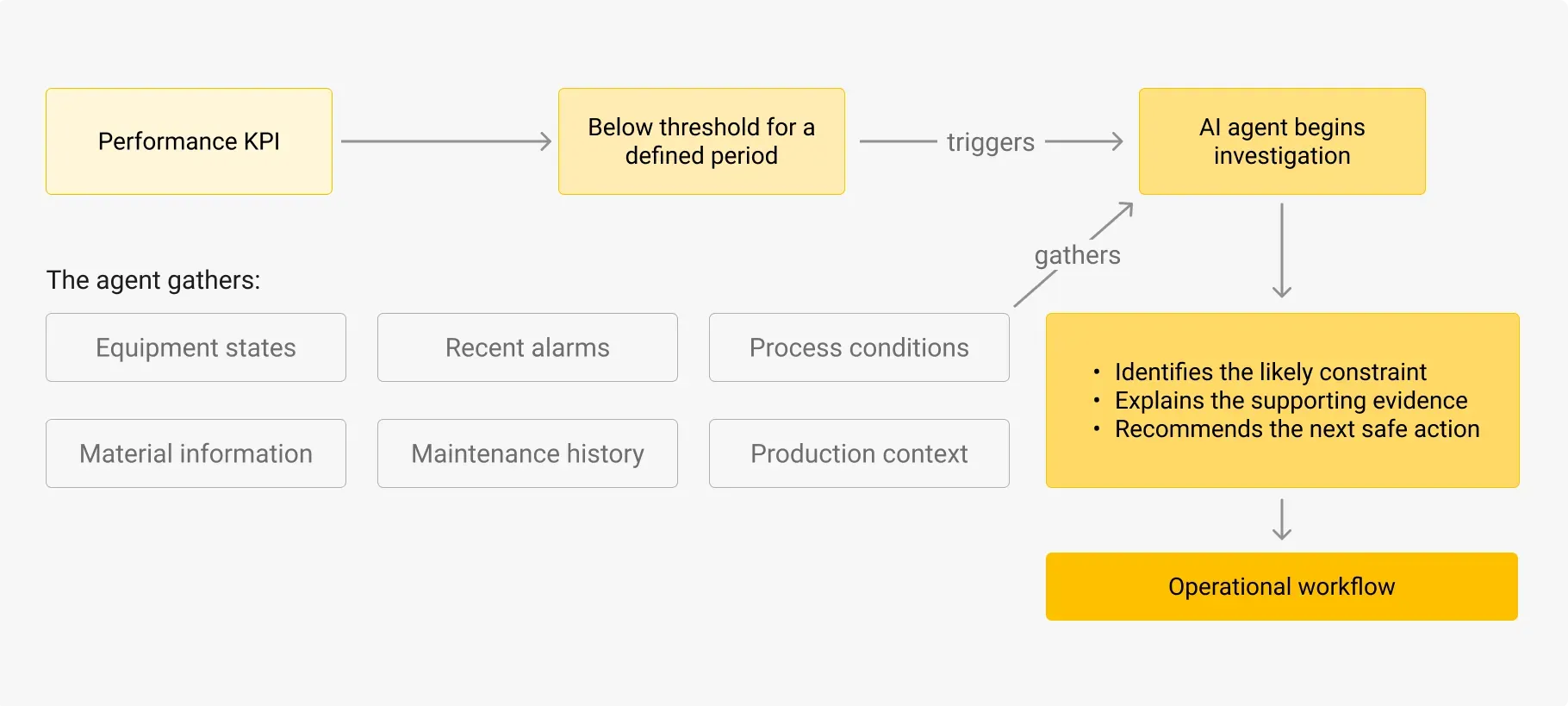 The response becomes part of the operational workflow rather than an isolated analytical observation.
Treat action as a governed process across manufacturing operations
Acting on operational data requires more control than simply generating an insight.
You must define who or what is allowed to act, under which conditions, on which systems and with what level of authority.
An AI agent that can read production data presents a different level of risk from one that can create a maintenance work order, place a batch on hold, modify a process setpoint, or release a product.
Your architecture should therefore distinguish between different action levels.
An agent may be allowed to retrieve information and summarize evidence without approval. It may be allowed to create a draft investigation or recommendation. It will need human approval before opening a formal deviation, changing a production schedule or updating a regulated record.
Direct control actions should be limited to clearly bounded use cases with validated logic, explicit authorization, and appropriate safety controls.
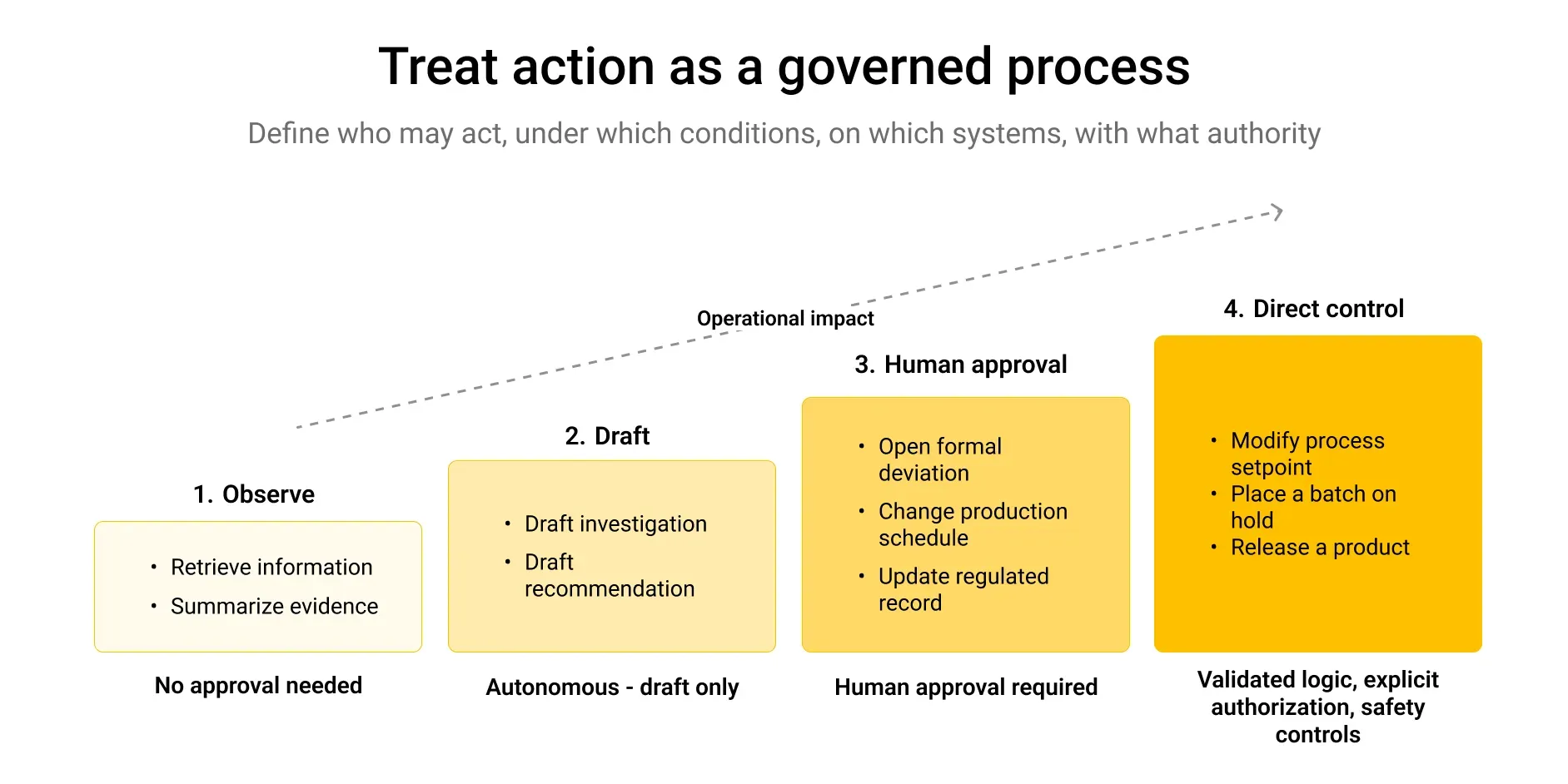 The principle is simple: the level of governance should increase with the potential operational impact of the action.
Define the role of your AI agents in manufacturing
An AI agent should have a clearly defined operational role.
It should not be given broad access to data and systems with an instruction to improve performance or resolve quality issues. Its responsibilities, tools, permissions, and boundaries should be explicit.
A quality-investigation agent, for example, may be authorized to:
Subscribe to quality and performance indicators
Retrieve relevant batch and process context
Query approved operational systems
Compare current conditions with previous cases
Assemble supporting evidence
Identify likely contributing factors
Draft an investigation summary
Recommend the next approved action
Escalate the case to an authorized quality representative
It may not be authorized to alter process settings, release a batch, modify source records or close a deviation independently.
Defining the role in this way makes the agent easier to validate, govern and monitor.
It also allows you to evaluate whether the agent completed the task it was assigned rather than judging it against an open-ended objective.
Defining the role in this way makes the agent easier to validate, govern and monitor.
Trigger agents from trusted operational events
AI agents should not need to continually search every source system for possible problems.
Your Analyze layer should publish governed signals that indicate when attention may be required.
These signals may include:
A sustained KPI degradation
A detected process drift
A recurring equipment constraint
A quality-risk score
A laboratory-result exception
An unusual event sequence
A deviation between expected and actual material consumption
A maintenance-condition warning
The agent subscribes to the signals relevant to its role.
This event-driven approach allows agents to respond when a defined condition occurs, while the supporting operational context remains available through the Unified Namespace and semantic graph. It also reduces unnecessary processing and makes the reason for each investigation explicit.
Gather context before recommending action
A detected condition should be the beginning of an investigation, not the conclusion.
A performance decline may have several possible causes. It could be related to equipment, materials, process conditions, upstream starvation, downstream blockage, quality inspection, maintenance activity or a planned production state.
An agent should therefore gather the context required to distinguish between these possibilities.
For a sustained decline in line performance, the agent may evaluate recent equipment-state changes, stop reasons, alarm sequences, cycle-time trends, material availability, active work orders, quality holds and maintenance events.
In a life-sciences process, the same agent may also need to determine whether the operation is waiting for an approved laboratory result, whether the current phase has a mandatory hold time, or whether a quality review has deliberately paused progression.
Context prevents the agent from recommending action based on an incomplete interpretation of the signal.
Use the semantic graph for agentic reasoning
The semantic graph gives the agent a structured way to navigate operational relationships.
Instead of searching systems independently and relying on naming conventions, the agent can move from a detected KPI to the line it describes, the equipment that belongs to that line, the active process or batch, the material being used, the relevant quality results, and the responsible organizational roles.
For example, the agent may begin with a degraded line-performance KPI and determine that:
The KPI describes Packaging Line 3
The line contains Filler 3A, Capper 3B, and Labeler 3C
Most micro-stoppages originated from Capper 3B
Capper 3B has an open maintenance notification
The current batch uses a packaging-material lot associated with similar stoppages
Product-quality results remain within specification
A maintenance technician with the required qualification is available
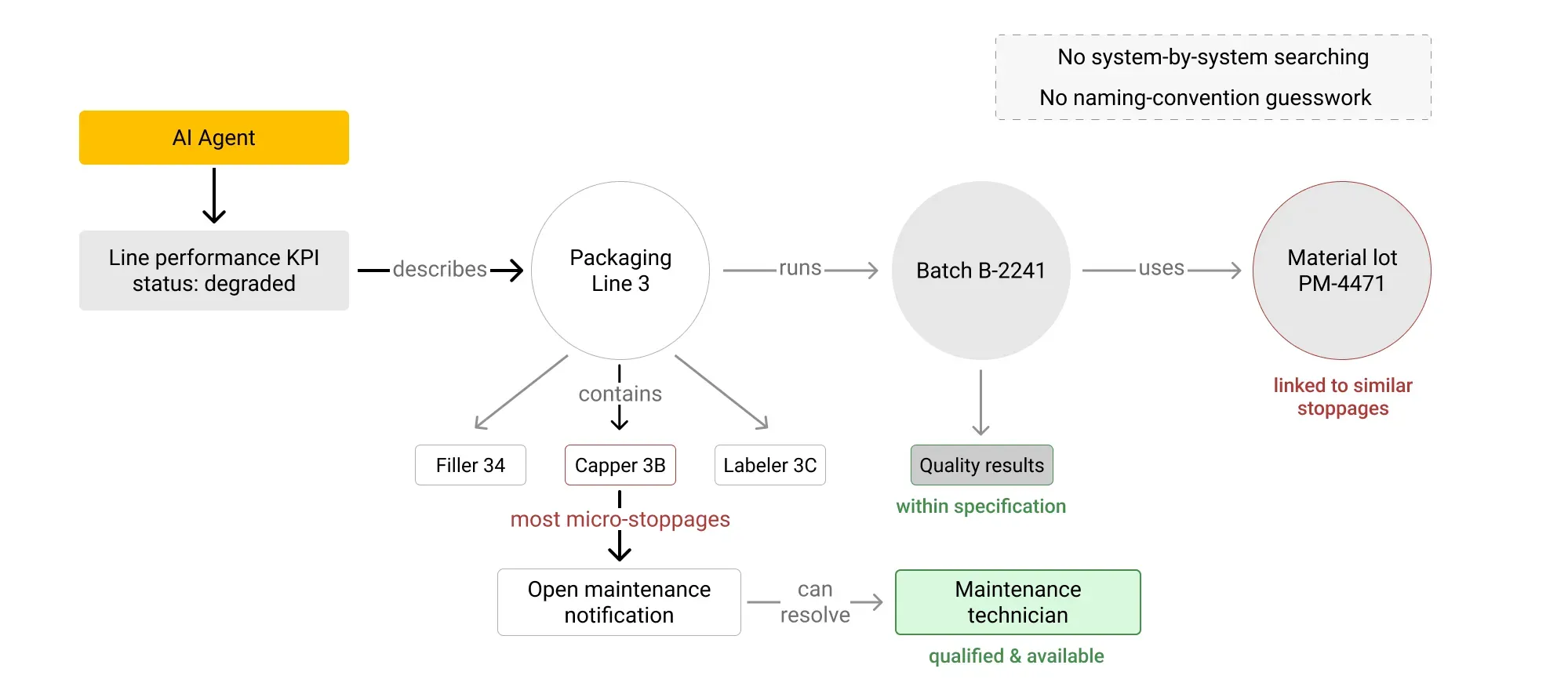 The graph does not make the decision on behalf of the agent. It gives the agent a governed representation of the relationships needed to investigate the condition.
Separate reasoning from execution
Your architecture should separate the process of determining what should happen from the mechanism that carries out the action.
An agent may analyze evidence and recommend that a maintenance inspection be performed. A workflow engine, CMMS integration, or authorized user should then create and assign the work order according to your approved business process.
This separation gives you clearer control over permissions, approvals, auditability, and error handling.
It also prevents the AI model from interacting directly with critical systems unless that interaction is explicitly required and governed.
A practical sequence may be:
Detect a condition
→ Gather operational context
→ Evaluate possible causes
→ Explain the supporting evidence
→ Recommend an approved response
→ Request authorization where required
→ Execute through a governed system interface
→ Verify the outcome
This creates a controlled loop from insight to action.
Keep humans in the loop for high-impact AI decisions
Human involvement should not be treated as a temporary limitation that you remove once the AI becomes more capable.
In many manufacturing decisions, especially those involving quality, safety, compliance or production release, human judgment and accountability are part of the required operating model.
An agent may significantly reduce the effort required to reach a decision. It can gather records, reconstruct timelines, identify relevant deviations, compare similar cases, and explain likely causes. However, an authorized person may still need to approve the final action.
For example, an agent investigating a potential quality deviation could prepare the evidence and recommend that the batch be placed on hold. The quality representative would review the recommendation and authorize the formal status change.
This approach combines the speed and scale of AI with appropriate operational accountability.
Constrain actions through policies and permissions
Every action-capable agent should operate within explicit policies.
These policies should define:
Which data the agent can access
Which tools and systems it can use
Which actions it can initiate
Which actions require approval
Which actions are prohibited
The conditions under which it must escalate
The maximum time or scope of an investigation
The evidence required before making a recommendation
Access should follow the principle of least privilege.
An agent responsible for equipment-performance investigation should not automatically have permission to view sensitive laboratory records or modify production parameters. Permissions should also be contextual: An agent may be allowed to create a maintenance recommendation for a specific site but not for every factory in the enterprise.
These constraints should be enforced by the architecture rather than expressed only in the agent’s prompt.
Make every decision explainable
An agent should be able to explain what triggered its action, which information it considered, how it reached its conclusion and why it selected the recommended response.
The explanation should reference the underlying operational evidence.
For example, the agent may state that it detected a sustained performance decline because the rolling KPI remained below the approved target for 20 minutes. It may explain that the most likely constraint is a capping machine because its micro-stoppage count increased, its cycle time deteriorated, and an open maintenance notification describes a related mechanical issue. It should also identify uncertainty and alternative explanations.
Explainability allows an operator or engineer to evaluate the recommendation rather than simply accept an opaque result. In quality workflows, this explanation may also become part of the investigation record.
Preserve a complete audit trail
Every agentic workflow should produce a traceable record.
You should capture the triggering event, the agent identity, the data accessed, the tools invoked, the evidence retrieved, the reasoning summary, the recommendation, the approvals received, the action executed and the resulting outcome. You should also record the versions of the agent, model, policies and analytical services involved.
This allows you to reconstruct what happened, evaluate whether the agent behaved as intended, and investigate failures or unexpected outcomes. Auditability is especially important when agent outputs influence quality, maintenance, production scheduling or regulated records.
Verify the outcome and close the loop
An action should not be considered complete simply because a command was issued or a workflow was created. Your architecture should verify whether the action produced the intended result.
If a maintenance inspection was recommended, the system should determine whether the work order was created, accepted, completed and followed by an improvement in the relevant operational condition.
If an operator changed a process condition, the analytical layer should continue monitoring the process to determine whether the deviation was resolved.
The outcome can then be published back into the operational architecture. This creates a closed feedback loop:
Insight
→ Investigation
→ Decision
→ Action
→ Verification
→ Updated operational state
Verified outcomes can also improve future recommendations by providing examples of which actions were effective under similar conditions.
Start with bounded, high-value use cases
You should not begin by deploying a general-purpose agent across your entire manufacturing operation. Start with a specific operational problem where the trigger, required evidence, permitted actions, and success criteria can be clearly defined.
Good initial use cases often involve investigation and coordination rather than direct autonomous control.
Examples include:
Investigating performance degradation
Triaging quality deviations
Gathering evidence for batch review
Explaining repeated equipment stoppages
Recommending maintenance actions
Identifying the likely source of process drift
Preparing shift-handover summaries
Coordinating responses to material or supply interruptions
These use cases can deliver meaningful value while allowing you to test governance, permissions, human approvals and auditability.
You can expand the level of autonomy only after the system has demonstrated reliable performance within its defined boundaries.
What you should have at the end of the act stage
By the end of this stage, you should have a governed operational-action layer that connects trusted insights to defined workflows.
You should have event-driven agent triggers, clearly scoped agent roles, controlled access to operational context, policy-based permissions, human approval where required, auditable system integrations, and a feedback loop that verifies outcomes.
Your AI agents should not be operating on raw data or making unconstrained decisions. They should be working from trusted context, governed analytical signals, explicit operational roles, and approved action pathways.
This is what turns AI from an isolated analytical tool into a dependable participant in manufacturing operations.
Across the complete architecture, the progression is now clear:
Connect makes operational data available.
Contextualize makes it understandable and trustworthy.
Analyze turns it into decision-ready intelligence.
Act converts that intelligence into governed operational outcomes.
Conclusion
Manufacturers don't lack data. They’re missing a coherent path from raw signals to trusted action, and that's the gap this whitepaper set out to close.
Connect gives your teams and systems real-time access to what's happening across machines, control systems and enterprise applications. Contextualize turns that access into shared, governed meaning, so the same asset, batch and KPI mean the same thing wherever they're used. Analyze turns that trusted context into standardized metrics and decision-ready insight. Act turns insight into a governed response, whether the actor is an operator, a workflow engine or an AI agent.
Each stage depends on the one before it.
An AI agent cannot reason reliably about a signal it cannot access, and it cannot recommend a safe response to an insight it cannot first explain. That dependency is also why isolated pilots stall: the shortcuts that get one use case live quickly are usually the reason the next one takes just as long to build.
The manufacturers who build this foundation now won't need to retrofit trust into their architecture later, once they're ready to delegate real decisions to an AI agent.
You don't need an agentic AI strategy to benefit from this work today. Real-time visibility, standardized KPIs and faster decision support create value the moment you connect, contextualize and analyze your operational data. But for most manufacturers, agentic AI sits somewhere on the roadmap, even before the timeline is fixed. When you're ready to extend into it, this architecture lets you do it on your terms, with governance and human accountability built in from the start rather than added after the fact.
Every month spent extending today's point-to-point integrations instead of decoupling them adds to the eventual cost of replacing them.
Read our whitepaper, Building a scalable data foundation for real-time operational intelligence. The four-stage approach in this whitepaper isn't a one-time project. It's the operating model that keeps your architecture flexible enough to support whatever comes next, from a new analytics platform to your first governed AI agent.
You don't have to solve every stage at once. Most manufacturers start with a single line or site, prove the model, and extend it from there.
Talk to HiveMQ about where your architecture stands today and where connecting, contextualizing, analyzing or acting on your operational data would create the most immediate value.

Kudzai Manditereza
Kudzai is a tech influencer and electronic engineer based in Germany. As a Senior Industrial Solutions Advocate at HiveMQ, he helps developers and architects adopt MQTT, Unified Namespace (UNS), IIoT solutions, and HiveMQ for their IIoT projects. Kudzai runs a popular YouTube channel focused on IIoT and Smart Manufacturing technologies and he has been recognized as one of the Top 100 global influencers talking about Industry 4.0 online.