A Data Maturity Path to Intelligent Data Center Optimization
Three-layer data maturity path enables intelligent data centers: Data Streaming, Data Intelligence, and Agentic AI Orchestration for digital twins and autonomous control.
Blog
HiveMQ empowers data centers to achieve higher efficiency and uptime with enterprise-grade MQTT data streaming. By unlocking real-time intelligence across cooling, power, and workloads, HiveMQ helps operators deliver resilient, AI-ready infrastructure.
AI workloads and surging rack densities are pushing data centers beyond the limits of traditional monitoring. Four critical obstacles stand out:

Cooling, power, and compute telemetry sit in silos, blocking a unified view and slowing response times.

Modern AI workloads drive volatile spikes that static monitoring and capacity planning cannot handle.

Surging rack densities demand real-time thermal and power insight, yet legacy tools lack the fidelity to act before failures.

Legacy dashboards overwhelm with charts but offer no intelligence, slowing operators when every second counts.
Traditional monitoring was designed for predictable IT environments. The rise of AI-driven workloads has made data centers far more volatile, with surging densities and split-second orchestration demands. Legacy systems can’t transform siloed telemetry into decisions, leaving operators unable to meet the new standard for uptime, efficiency, and AI-readiness.
Demand for AI-ready data center capacity will rise at an average rate of 33 percent a year. Around 70 percent of total demand for data center capacity will be for data centers equipped to host advanced-AI workloads by 2030.
McKinsey & Company
HiveMQ provides the enterprise-grade platform that transforms siloed telemetry into real-time, decision-ready intelligence. Four core capabilities set HiveMQ apart:
Read Data Sheet
Legacy systems deliver poor-quality data that weaken billing accuracy, compliance, and SLAs. HiveMQ provides secure, high-fidelity MQTT and Sparkplug streaming, ensuring data is accurate, real time, and trusted for compliance and business-critical decisions.

Dashboards stop at data and leave operators blind to fast-moving risks. HiveMQ structures telemetry into decision-ready intelligence, powering predictive analytics, workload orchestration, and faster operator action when reliability matters most.

Traditional systems collapse under growth, slowing site onboarding and straining capacity. HiveMQ’s distributed architecture with high availability supports rapid expansion, powers millions of connections, and delivers proven reliability at enterprise scale.

Most platforms stop at monitoring and cannot support advanced workloads. HiveMQ prepares data centers to deliver structured, context-rich telemetry that fuels analytics, predictive optimization, and emerging AI-driven services across modern infrastructure.
Operational Efficiency
Unplanned Downtime
Service Reliability
HiveMQ delivers measurable results for the world’s most demanding data centers. By unlocking real-time data intelligence, operators achieve higher efficiency, reliability, and AI-readiness.
Legacy silos waste resources. HiveMQ unifies data to optimize cooling, power, and workloads, reducing costs and improving overall performance.
Traditional monitoring reacts too late. HiveMQ provides predictive insights that minimize downtime and ensure continuity.
Poor visibility drives waste and inflates energy costs. HiveMQ delivers accurate telemetry on power and environmental systems, helping operators cut consumption, and lower costs.
Billing errors and SLA gaps erode confidence. HiveMQ delivers transparent insights that strengthen compliance, billing accuracy, and customer confidence.
HiveMQ addresses the most urgent challenges operators face today, from compliance and onboarding to preparing infrastructure for AI-driven workloads.

Stream high-fidelity EPMS and BMS data in real time to guarantee transparent billing, SLA compliance, and ESG reporting. HiveMQ ensures operators can meet customer and regulatory commitments with confidence.

Simplify and accelerate the activation of new data center capacity. HiveMQ’s reliable, scalable streaming platform reduces operational bottlenecks and enables faster deployment of customer services.
Prepare data centers for next-generation services by structuring telemetry with Sparkplug and real-time streaming. HiveMQ powers predictive optimization, advanced analytics, and seamless integration with AI/ML platforms.
AI workloads, rising rack densities, and strict SLA requirements demand real-time visibility across power, cooling, and workloads. HiveMQ unifies telemetry from EPMS, BMS, DCIM, and environmental sensors into a trusted data backbone that feeds IT and AI systems. This enables operators to cut energy costs, improve uptime, and deliver AI-ready infrastructure.
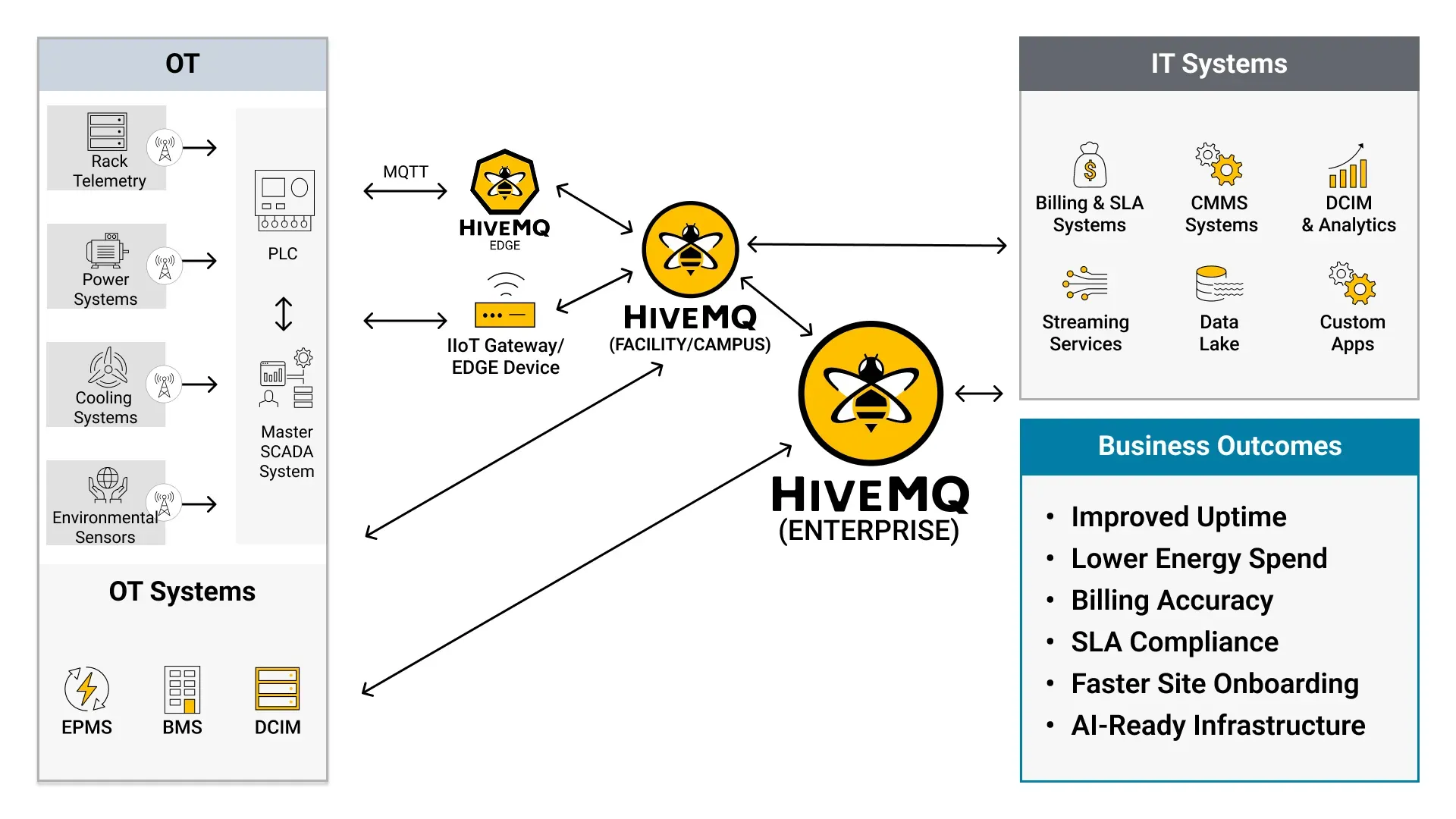
HiveMQ powers the shift from siloed monitoring to AI-native operations. By unifying OT, IT, and cloud ecosystems, HiveMQ transforms raw telemetry into distributed intelligence that drives efficiency, uptime, compliance, and AI readiness at scale.
Connect cooling, power, and environmental infrastructure with OPC UA, Modbus, BACnet, and more. HiveMQ streams high-fidelity telemetry in real-time, providing operators with a trusted foundation for informed action.
HiveMQ turns raw signals into contextual, decision-ready streams. This intelligence enables predictive maintenance, workload optimization, and faster response across the data center.
HiveMQ connects with Kafka, Snowflake, Databricks, and cloud platforms. By providing structured, reliable data, HiveMQ ensures analytics and AI pipelines deliver outcomes operators can trust.
Three-layer data maturity path enables intelligent data centers: Data Streaming, Data Intelligence, and Agentic AI Orchestration for digital twins and autonomous control.
Point-to-point integrations silo data and block real-time control. Learn why unified, event-driven architecture enables digital twins and Agentic AI in data centers.
Optimize data center operations with digital twins and agentic AI. Improve efficiency, capacity, and real-time decision-making.
Digital twins and Agentic AI enable autonomous data center operations: precision thermal control, stranded capacity recovery, and real-time optimization for AI workloads.
Learn how digital twins and agentic AI drive data center optimization by unifying telemetry, reducing uncertainty and unlocking stranded capacity. Read the blog.
Learn how Digital Twins and Agentic AI drive data center optimization. Solve power, thermal, and capacity challenges for AI-ready infrastructure. Read more.
Choose between a fully-managed cloud or self-managed platform. Our experts can help you with your solution and demonstrate HiveMQ in action.