Why strong MQTT adoption sets the stage for manufacturing data intelligence
The manufacturing sector has voted with its deployments: MQTT is the protocol of choice for industrial data. According to industry surveys, more than 60% of new Industrial Internet of Things (IIoT) projects now select MQTT as their primary messaging standard. That adoption rate has accelerated year over year, driven by MQTT's lightweight footprint, publish/subscribe architecture, and proven reliability in constrained environments.
But here is the question most manufacturing executives are now asking: we have data flowing reliably, so why aren't we getting more value from it?
The answer is not a technology gap. It is a context gap. And closing it is the highest-leverage investment a manufacturing organization can make in 2026.
Why has MQTT adoption accelerated so rapidly in manufacturing?
MQTT is a lightweight messaging protocol designed for environments where bandwidth is limited, connections are unreliable, and devices number in the thousands or millions. It uses a publish/subscribe model, meaning devices publish data to topics and any authorized system can subscribe to receive that data, without direct point-to-point connections.
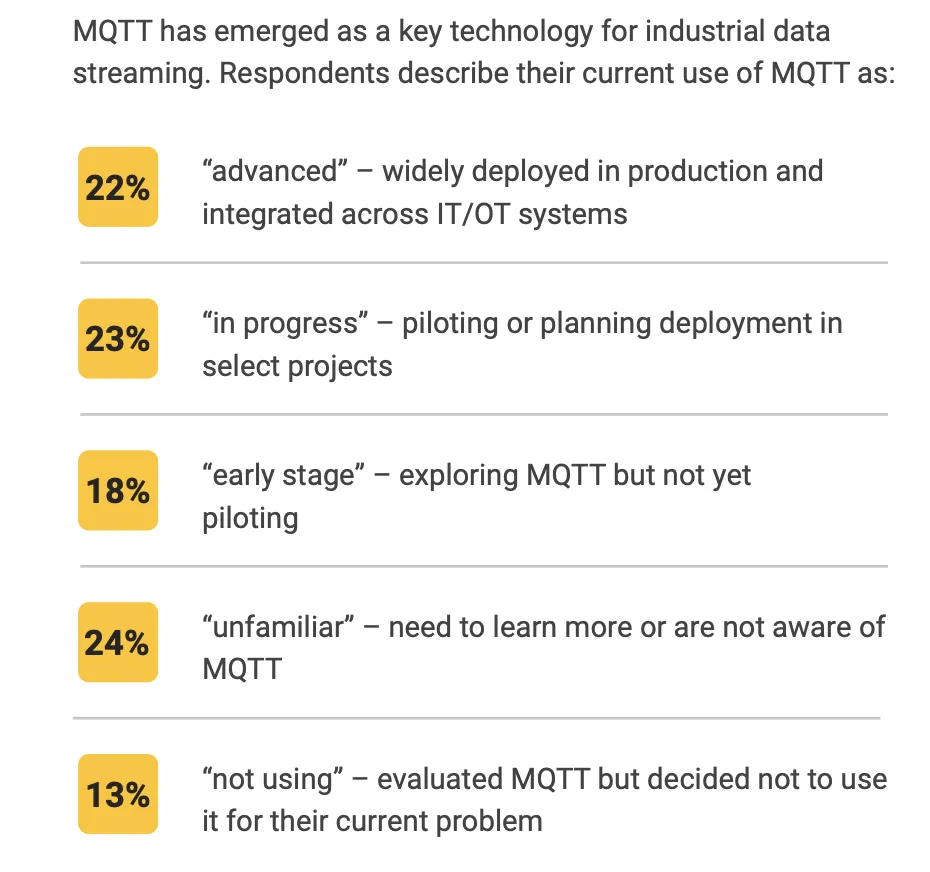 Three factors have driven MQTT's dominance in manufacturing:
Scale without complexity. A single MQTT broker cluster can handle millions of concurrent device connections. Compare that to traditional polling-based SCADA architectures, where every new data source requires configuration on both ends. MQTT's decoupled model means adding a new sensor or production line does not require rewiring the entire integration layer.
Edge-native design. MQTT was built for constrained environments. Its minimal packet overhead (as small as 2 bytes for the fixed header) means it works on low-power PLCs, edge gateways, and legacy equipment fitted with protocol adapters. This matters in manufacturing, where the shop floor has devices spanning decades of technology generations.
Enterprise-grade reliability. With Quality of Service (QoS) levels ranging from "at most once" to "exactly once" delivery, MQTT gives architects fine-grained control over message delivery guarantees. In a pharmaceutical batch process, you need every temperature reading delivered exactly once. On a vibration sensor sampling at 10 kHz, "at most once" keeps throughput high without overwhelming downstream systems.
The result: organizations that adopted MQTT now have reliable, real-time data streaming from their operational environments. That is a genuine achievement. Five years ago, most manufacturers struggled just to get data off the shop floor. Today, the plumbing works.
What problem does strong adoption of MQTT create?
Reliable data transport is necessary but not sufficient. The pattern HiveMQ sees across hundreds of manufacturing deployments follows a predictable arc:
Phase 1 (Months 1 to 6): Teams deploy MQTT, connect equipment, and celebrate the flow of real-time data. Dashboards light up. Executives see movement.
Phase 2 (Months 6 to 18): The volume of data grows. Topic namespaces expand organically. Different plants, different teams, different naming conventions. The MQTT topic plant3/line7/temp means something different from factory-east/assembly/temperature_c, but both carry temperature readings from similar equipment.
Phase 3 (Month 18 and beyond): Teams attempting advanced analytics, predictive maintenance, or cross-plant benchmarking discover they cannot reliably answer basic questions: What data do we have? What does it mean? Can we trust it? Who owns it?
This is the context gap. Data is streaming, but it lacks the semantic richness needed to drive decisions. According to McKinsey, most companies collect vast troves of process data but typically use them only for tracking purposes, not as a basis for improving operations.
Every HiveMQ deployment teaches the platform what works. Customers benefit from the accumulated pattern knowledge of hundreds of real implementations, not just their own. This pattern, where organizations solve connectivity only to hit a context wall, is the single most common trajectory HiveMQ observes across manufacturing customers.
How do you move from data transport to data intelligence?
The transition from data streaming to data intelligence does not require replacing your MQTT infrastructure. It requires extending it with three capabilities.
Discovery: What data exists?
In a typical multi-plant manufacturing operation, MQTT topic namespaces grow to tens of thousands of topics. New topics appear as equipment is added, processes change, or teams experiment. Without a discovery layer, no single person knows the full picture of what data is available.
Data discovery automatically catalogs every data source, topic, and schema flowing through the MQTT infrastructure. It answers the question: "What do we have?" This is the prerequisite for every downstream use case.
Context: What does it mean?
Raw MQTT payloads carry sensor values, timestamps, and device identifiers. They do not carry business meaning. A semantic model (the shared vocabulary of your organization) defines that "OEE" means Overall Equipment Effectiveness calculated by a specific formula, that "downtime" includes planned maintenance but excludes changeovers, and that "Line 7" in Plant 3 is equivalent to "Assembly Line G" in the ERP system.
A Semantic Graph takes this shared vocabulary and populates it with real entities and relationships: this specific CNC machine, on this specific line, producing this specific product, with these specific quality parameters. The graph makes implicit knowledge explicit and machine-readable.
Governance: Can we trust it?
Data without governance is a liability. Governance answers: Who can access this data? Is it fresh? Does it conform to our quality standards? When a shift supervisor bases a production decision on a temperature reading, they need confidence that the reading is current, accurate, and from the sensor they think it is from.
Policy-driven governance enforces data quality rules, tracks data lineage (where did this value originate and how was it transformed?), and manages access control, all within the streaming layer itself, not in a separate system.
Why should manufacturing executives prioritize data intelligence now?
The competitive case for data intelligence is measurable. Consider three scenarios common in discrete and process manufacturing:
Cross-plant benchmarking. A global automotive manufacturer with 14 plants wants to identify why Plant 6 achieves 12% higher OEE than Plant 9 on identical product lines. Without semantic context, comparing data across plants requires weeks of manual data wrangling by engineers who understand both plants' naming conventions. With a Semantic Graph, the comparison is queryable in minutes because "OEE" means the same thing everywhere.
Predictive maintenance at scale. A food and beverage company monitors vibration, temperature, and current draw on 4,000 motors across eight facilities. The MQTT data streams reliably. But training a predictive model requires labeled, contextualized data: which motor, which type, which operating regime, which failure mode. Without governance and context, data scientists spend 70 to 80% of their time on data preparation rather than model development.
Regulatory compliance. A pharmaceutical manufacturer must demonstrate batch traceability for FDA 21 CFR Part 11 compliance. MQTT delivers the process data in real time. But compliance requires proving data integrity, lineage, and access control. A governance layer native to the streaming infrastructure provides this without bolting on a separate compliance system.
In each case, the ROI comes not from moving more data, but from making existing data understandable and trustworthy.
How does HiveMQ extend the data streaming foundation?
HiveMQ has an in-built data intelligence product built natively on top of the HiveMQ Broker. "Natively" is the key word: data does not need to be copied, re-ingested, or moved to a separate analytics platform. It operates on the same data, in the same infrastructure, as it streams, providing:
Automated data discovery across the entire MQTT topic namespace. New topics, schema changes, and data sources are cataloged as they appear.
Semantic Graph construction that maps entities, relationships, and properties according to your organization's ontology. This is the populated, queryable representation of your operational reality.
Policy-driven governance that enforces data quality rules, manages access, and tracks lineage at the broker level.
Anomaly detection that identifies deviations in streaming data based on configurable thresholds and learned baselines.
The architecture reinforces a principle that matters to transformation leaders: you do not need to rip and replace your MQTT infrastructure to add intelligence. The streaming layer is the foundation. Intelligence is a natural extension of that foundation.
For organizations following the Unified Namespace (UNS) design pattern, HiveMQ adds the semantic and governance capabilities that turn a well-organized topic hierarchy into a true single source of truth. A UNS without context is a directory. A UNS with context is an operational knowledge system.
Ready to explore how data intelligence can multiply the value of your MQTT investment? Schedule a consultation with a HiveMQ solutions architect to assess your current streaming infrastructure and map the path to operational intelligence.
What does the path forward look like?
Manufacturing leaders evaluating this transition should consider a phased approach:
Audit your current state. How many MQTT topics do you have? How consistent are your naming conventions across plants? Where are the data quality gaps? This baseline determines the scope of the intelligence layer.
Define your semantic model. Start with the 20 to 30 terms that matter most to your business: OEE, cycle time, downtime categories, equipment types, product hierarchies. Align definitions across operations, engineering, and finance. This is organizational work, not just technology work.
Deploy discovery and governance first. Before building sophisticated analytics, ensure you can answer "what data do we have?" and "can we trust it?" These capabilities deliver immediate value by eliminating the manual data archaeology that currently consumes engineering hours.
Expand to semantic modeling and analytics. With discovered, governed data, build out the Semantic Graph and enable cross-plant, cross-domain analysis. This is where the compounding returns begin.
The organizations extracting the most value from their MQTT investments are the ones treating the streaming layer as a foundation, not a ceiling. HiveMQ's enterprise MQTT platform provides that foundation. Pulse extends it into intelligence. And the progression is designed so that each step builds on the last, with no wasted investment.
Frequently Asked Questions

Kudzai Manditereza
Kudzai is a tech influencer and electronic engineer based in Germany. As a Senior Industrial Solutions Advocate at HiveMQ, he helps developers and architects adopt MQTT, Unified Namespace (UNS), IIoT solutions, and HiveMQ for their IIoT projects. Kudzai runs a popular YouTube channel focused on IIoT and Smart Manufacturing technologies and he has been recognized as one of the Top 100 global influencers talking about Industry 4.0 online.