From predictive maintenance to autonomous operations: The industrial AI maturity journey
Ask ten manufacturing leaders where their plant sits on the industrial AI maturity curve, and most will describe a stage they have not reached.
A plant running mostly reactive work orders will call itself "predictive" because it owns a condition monitoring dashboard. The gap is not ambition. It is that sensors, historians and dashboards do not add up to the data infrastructure the next stage actually needs.
Why do most manufacturers overestimate their industrial AI maturity?
Most manufacturers overestimate their industrial AI maturity because they measure it by which tools they have bought, not by what their data infrastructure can actually deliver. A plant can own a predictive maintenance license and still run on polling-based data collection that predictive models were never designed for.
How real is the maturity gap?
The gap shows up consistently across industry research. A plant running 60% reactive work orders will still claim predictive maintenance status because it owns a condition monitoring system. The SMRP maturity framework defines five distinct levels, reactive, preventive, condition-based, predictive, and prescriptive or autonomous, each with measurable benchmarks for reactive work percentage, unplanned downtime, and maintenance cost per operating hour.
Most manufacturers have deployed sensors, historians, and analytics dashboards. That is real progress. But those tools do not automatically become the data infrastructure the next maturity stage requires.
Why is the bottleneck data, not AI?
Every stage transition in industrial AI maturity is a pipeline architecture decision before it is a modeling decision. Moving from condition-based to predictive means shifting from polling to continuous, high-frequency sensor streams. Moving from predictive to prescriptive means contextualizing that data across assets, sites, and systems in a Unified Namespace (UNS), not just adding more dashboards. Moving from prescriptive to autonomous means that data has to be governed, reliable, and machine-consumable without a human checking it at every step.
At each transition, the organizations that stall are the ones that upgraded their models without upgrading their data layer underneath them.
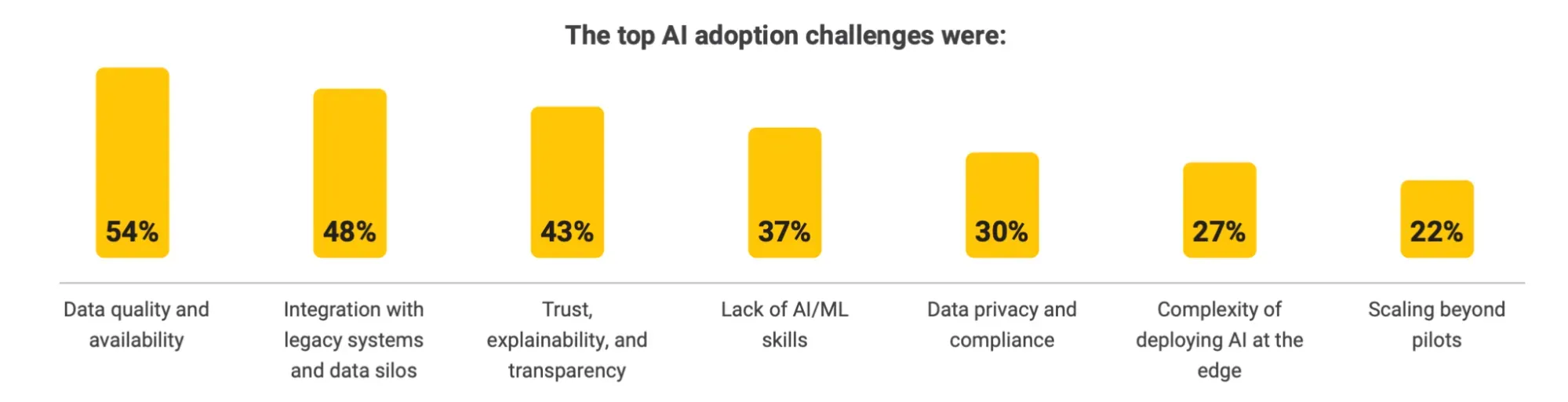 Source: Accelerating AI Use Cases in 2026 Report by HiveMQ. Download here.
What are the six stages of industrial AI maturity?
Industrial AI maturity runs from reactive maintenance through autonomous operations, and each stage places a different demand on the data layer beneath it. The AI capability tends to get the attention. The data requirement is what actually determines whether that capability works in production.
Stage 1: Reactive - run to failure
There is no proactive monitoring at this stage. Maintenance happens after a breakdown or when an operator notices a problem.
Data requirement: Minimal. Basic event logs and manual records are enough. No pipeline architecture is needed yet.
Manufacturers often stay here longer than intended because data lives in siloed historians and CMMS systems with no integration layer to surface patterns across them.
Stage 2: Preventive and condition-based monitoring
This stage combines calendar-based preventive maintenance schedules with threshold-triggered alerts from condition monitoring sensors.
Data requirement: Polling at regular intervals is sufficient. SCADA and historian systems can handle this workload without additional investment.
The ceiling here is real. A threshold alert tells you a problem has already occurred, not that one is developing. Catching an early failure signature requires higher-frequency data than polling can provide.
What breaks at the ceiling of Stage 2:
15-minute polling averages mask the vibration signatures that precede bearing failure by days or weeks
Threshold alerts fire once the problem is already critical, not early enough to avoid unplanned downtime
Moving to predictive requires continuous data streams, not scheduled polling, which is a pipeline architecture change, not a model upgrade
Stage 3: Predictive maintenance
At this stage, machine learning models trained on historical failure data identify degradation patterns and forecast failure windows before thresholds are breached.
Data requirement: Continuous high-frequency sensor streams (vibration at kHz, thermal, acoustic), clean labeled historical failure data per asset class, and consistent schema across assets.
This is where most manufacturers stall. They have the model capability, but their pipeline still delivers polling averages instead of the continuous streams predictive models require.
What data infrastructure predictive maintenance actually needs:
Event-driven data collection, where MQTT publish/subscribe (pub/sub) sends sensor data the moment it changes rather than on a fixed schedule
Edge store-and-forward, so connectivity gaps on the plant floor do not create gaps in training data or inference inputs
Schema consistency across assets, since a vibration model trained on one site's tag structure breaks silently when deployed to a site with different naming conventions
For a deeper look at how event-driven collection supports these models, see HiveMQ's guide to AI use cases in industrial automation.
Stage 4: Prescriptive AI
Prescriptive AI does not just predict failure. It recommends the specific action, timing, parts, and labor required to optimize both asset life and production continuity.
Data requirement: Data contextualized across asset type, maintenance history, production schedule, parts inventory, and workforce availability, not just sensor telemetry on its own.
A UNS is the prerequisite here. Prescriptive AI cannot optimize across systems it cannot see. Data from PLCs, CMMS, ERP, and MES has to be normalized into a single topic hierarchy the model can consume from.
Why prescriptive AI fails without a Unified Namespace:
A prescriptive recommendation requires correlating sensor data with maintenance history, production schedule impact, and parts availability at the same time
If those sources sit in separate silos with no shared data layer, the model can only optimize within one system at a time
A UNS built on MQTT is what collapses those silos into a single data layer prescriptive AI can actually consume
To learn more, read our blog Why Agentic AI Makes the Unified Namespace a Strategic Imperative.
Stage 5: Autonomous operations
At the final stage, AI agents perceive conditions across the operational stack, reason across systems, and act, scheduling maintenance, adjusting process parameters, rerouting production, without waiting for human approval on routine decisions.
Data requirement: Everything Stage 4 requires, plus end-to-end reliability guarantees. A person can tolerate a missed alert. An autonomous agent acting on bad data can cause real operational harm.
This is where governance stops being optional: schema validation in flight, MQTT quality of service (QoS) guarantees at the broker layer, and audit trails for every agent action.
IDC projects that by 2027, 40% of all operational data will be integrated across applications autonomously by AI agents built for specific data pipelines. The infrastructure investment required to get there starts back at Stage 3.
What changes in your data infrastructure at each AI Maturity stage transition?
The transitions between stages are infrastructure decisions as much as they are technology decisions. The table below maps what changes at each step.
Stage transition | What changes in the AI layer | What has to change in the data layer |
|---|---|---|
Reactive to Preventive | Time-based scheduling logic replaces run-to-failure | Basic sensor integration; historian for record-keeping |
Preventive to Condition-Based | Threshold alert rules replace calendar schedules | Polling-based collection; SCADA integration is sufficient |
Condition-Based to Predictive | Machine learning models replace threshold rules | Polling must become continuous, event-driven streams; schema consistency required across assets |
Predictive to Prescriptive | Optimization models replace single-output predictions | UNS required; data contextualized across sensor, CMMS, ERP, and production schedule |
Prescriptive to Autonomous | AI agents replace human approval on routine decisions | End-to-end schema governance; QoS reliability guarantees; broker-level audit trails for agent actions |
What MQTT data infrastructure does each industrial AI maturity stage require?
Think of this section as a reference worth bookmarking if you are mapping your own plant against the maturity curve. It maps the specific infrastructure component to the stage that requires it.
What can polling-based infrastructure support, and where does it stop?
Stages 1 and 2, reactive through condition-based, can be served entirely by SCADA polling, historian storage, and threshold alerting. A 15-minute polling average is sufficient to track trends over days and weeks. It is not sufficient to detect the vibration signatures that precede bearing failure.
The ceiling sits at Stage 2. Any maturity journey that tries to reach predictive AI on polling-based data collection will produce models that underperform, and teams that cannot explain why.
What does event-driven architecture unlock?
Event-Driven Architecture (EDA) is what makes Stages 3 and 4 possible. MQTT pub/sub replaces polling: data publishes the instant a sensor value changes, giving predictive models the continuous streams they require. Edge store-and-forward prevents data loss during connectivity gaps, protecting training data integrity in plant floor environments where networks are unreliable. A UNS normalizes data from PLCs, SCADA, CMMS, and MES into a single topic hierarchy, the prerequisite for prescriptive AI that has to reason across systems.
A Unified Namespace is the prerequisite for agentic AI in manufacturing. Learn what CXOs must build before deploying AI agents on operational data.
What does autonomous industrial operations require beyond event-driven architecture?
Stage five needs the same event-driven foundation, with governance and reliability requirements tightened to a standard human decision-making never demanded. That means schema validation in flight, since an autonomous agent acting on a corrupted sensor reading does not just produce a wrong dashboard, it can trigger an incorrect maintenance action or process adjustment. It means QoS 2 delivery guarantees for control-critical events, so agent decision inputs are never duplicated or lost. And it means broker-level audit trails, so every message an agent acts on can be traced for operational review and regulatory compliance.
This is not an incremental improvement on Stage 3 and 4 infrastructure. It is the same architecture, with governance tightened to the standard autonomous action demands.
Where does agentic AI fit in the maturity journey?
Agentic AI is autonomous operations made operational. AI agents perceive conditions from live MQTT streams, reason across the Unified Namespace, and act without waiting for human approval on routine decisions.
The maturity journey this post describes is the infrastructure prerequisite for that work. Agents cannot run reliably on polling-based pipelines, siloed data, or ungoverned streams. Most manufacturers will encounter agentic AI as an extension of their Stage 4 prescriptive infrastructure, not as a separate deployment: the same UNS, the same broker, the same governance layer, with an agent layer added above it.
IDC projects that autonomous production scheduling will reach 40% adoption among manufacturers with scheduling systems in place by 2026. The organizations getting there first are the ones that invested in data infrastructure at Stage 3, not the ones that bought the best model at Stage 4.
Read more about how agentic AI uses the MQTT data layer in industrial operations.
Why HiveMQ for the industrial AI maturity journey
Each part of the HiveMQ platform maps to a specific transition in this journey, not a generic feature list.
HiveMQ Edge supports the Stage 2 to Stage 3 transition. It translates Modbus and OPC UA into MQTT at the plant floor, replacing polling-based collection with event-driven streams, and its store-and-forward capability maintains data integrity across intermittent connectivity.
HiveMQ Broker is the pub/sub backbone that scales from Stage 3 through Stage 5. Horizontal clustering handles the high-throughput ingestion predictive and prescriptive AI require, while persistent sessions and QoS levels provide the reliability autonomous operations demands.
HiveMQ Data Hub supports Stage 4 and Stage 5. Schema validation and payload normalization in flight help ensure the data quality prescriptive and autonomous AI require, catching schema drift and unit inconsistencies before they reach the model
HiveMQ’s Intelligence layer adds real-time analytics and AI-ready pipelines on top of the MQTT data layer.
Native integrations with AWS, Azure, Google Cloud, Kafka, and Snowflake connect operational data to cloud AI platforms without custom pipeline engineering at each stage.
HiveMQ is proven at scale across leading manufacturers, including BMW, Eli Lilly, Mercedes, and Ford, moving 140 billion data points a day across more than 13 million sensors. See HiveMQ's case studies for more.
Conclusion: Industrial AI maturity starts with your data layer
Manufacturers rarely stall because the AI capability is not there. They stall because the data infrastructure the next stage requires was never built. Predictive maintenance needs event-driven streams, not polling averages. Prescriptive AI needs a Unified Namespace, not more dashboards. Autonomous operations need governance and reliability guarantees that a human decision-maker never demanded. Agentic AI is the destination this entire journey is building toward, and it is only reachable by the organizations willing to invest in the data layer before the model, not after.
Ready to see where your UNS maturity curve sits? Try HiveMQ UNS Maturity Assessment today or request a demo to map your data infrastructure against the stage you are trying to reach.
FAQs

Kudzai Manditereza
Kudzai is a tech influencer and electronic engineer based in Germany. As a Senior Industrial Solutions Advocate at HiveMQ, he helps developers and architects adopt MQTT, Unified Namespace (UNS), IIoT solutions, and HiveMQ for their IIoT projects. Kudzai runs a popular YouTube channel focused on IIoT and Smart Manufacturing technologies and he has been recognized as one of the Top 100 global influencers talking about Industry 4.0 online.