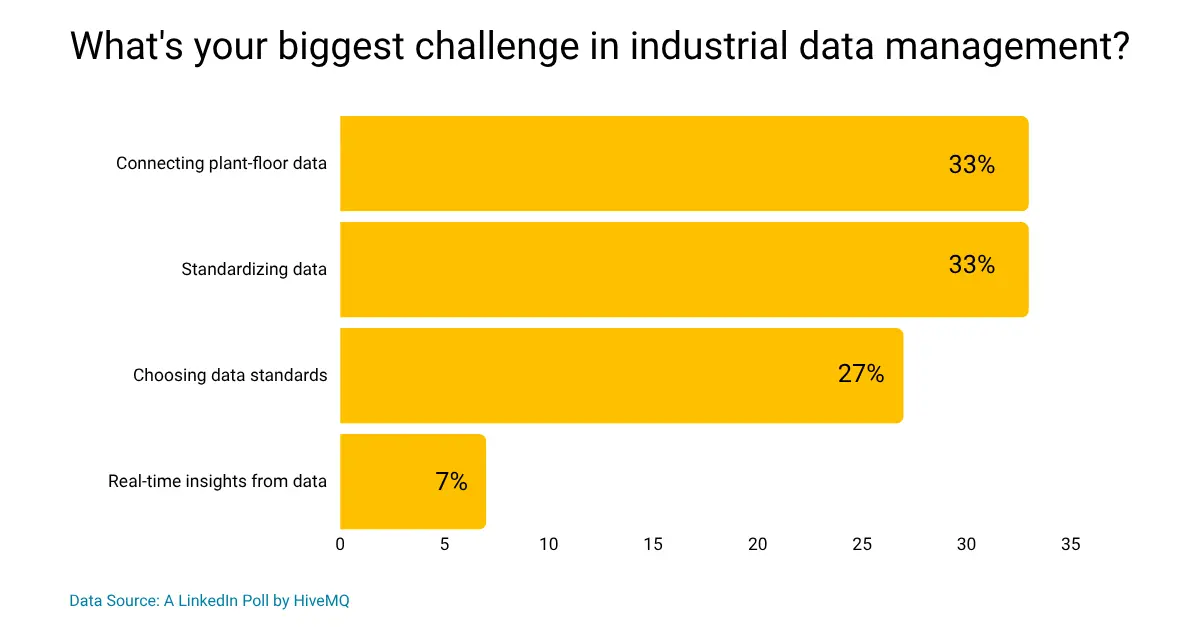
Real-time data is a necessity in the manufacturing industry today. Despite the promises of Industry 4.0, many manufacturers still encounter significant challenges when attempting to stream real-time data across their industrial systems. We recently conducted a poll, in which 33% of respondents stated that connecting plant-floor data was a challenge, while another 33% reported that standardizing data was a challenge.
Integrating brownfield devices, achieving millisecond-level responsiveness, maintaining reliable connectivity across thousands of sensors, or transforming raw machine data into usable information that flows seamlessly from edge to cloud is anything but easy. If you’re still relying on batch-based data collection, custom point-to-point integrations, or legacy protocols that don’t scale, you’re likely leaving efficiency, uptime, and innovation on the table. That’s where MQTT comes to the rescue, as it serves as the backbone protocol for scalable, real-time Industrial IoT (IIoT) data streaming.
In this blog post, we’ll explore the common pitfalls that manufacturers face when building industrial data streaming pipelines and how MQTT offers practical and scalable solutions.
Common Industrial IoT Data Streaming Challenges
Challenge 1: Integrating Legacy Systems and Diverse Protocols
Manufacturers can’t afford to rebuild their operations from scratch. The reality is that most factory floors are filled with legacy systems, such as PLCs speaking Modbus, machines running on proprietary protocols, and SCADA systems designed long before the cloud was a thing. These systems weren’t built to share data in real time, much less integrate with enterprise analytics or cloud platforms. Yet business leaders are expected to deliver predictive insights, operational agility, and enterprise-wide visibility without replacing critical assets or disrupting production.
This is where MQTT proves essential. Its lightweight, event-driven architecture is designed for constrained environments, making it ideal for bridging OT systems with modern IT infrastructure. Additionally, MQTT enables the creation of a Unified Namespace (UNS), providing a structured, real-time data layer that all systems can access. This high-quality data stream serves as the foundation for AI readiness and scalable industrial intelligence.
To make this possible, MQTT gateways like HiveMQ Edge act as protocol translators. They convert data from legacy industrial protocols into MQTT messages, allowing legacy assets to participate in a unified data streaming architecture. It’s the most cost-effective way to modernize without massive hardware investments or downtime. If you’re not using MQTT to bridge legacy protocols, you’re either spending too much or getting too little.
Challenge 2: Scaling Real-Time Data Collection Across Thousands of Devices
When manufacturers scale from PoC to production, what works for one production line often fails or cannot be cost-effectively implemented at scale across an entire enterprise.
MQTT is designed for scalability. Its publish-subscribe architecture enables easy onboarding of machines through a shared infrastructure. Hierarchical topic trees support the creation of a semantic namespace, while broker clustering ensures high data availability, even as network traffic scales to millions of connections.
This allows manufacturers to grow from a single line to global operations without redesigning the architecture. IoT Data Streaming platforms like HiveMQ that can handle millions of concurrent connections while ensuring low latency, message reliability, and end-to-end observability give manufacturers the confidence to scale industrial IoT data streaming without compromise.
Challenge 3: Ensuring Reliability Over Unstable Networks
Industrial networks often span Wi-Fi dead zones, congested 3G gateways, or harsh environments where connectivity is intermittent. In data-driven manufacturing, even a few seconds of lost data can lead to production downtime, missed quality events, or incorrect analytics. MQTT demonstrates its industrial-grade reliability because it is designed for low-bandwidth, lossy networks. MQTT keeps the data flowing even when the connection is weak. This is thanks to:
- Keep-alive mechanisms that monitor connection health and detect network failures early.
- Persistent sessions that ensure no data is lost when devices disconnect unexpectedly.
- Retained messages that guarantee that critical state information (e.g., last machine status) is available to new subscribers.
- Last Will and Testament (LWT) that alerts subscribers immediately when a device unexpectedly goes offline, thus enabling a fast response.
While data loss in IIoT can shut down production, skew quality metrics, or trigger false alarms, duplicated messages can overwhelm consumers and create inconsistencies. With configurable QoS 0 (at most once), QoS 1 (at least once), and QoS 2 (exactly once), MQTT gives architects control over delivery guarantees based on the criticality of the data stream.
Together, these features make MQTT ideal for maintaining data integrity and system resilience, even in the most unpredictable network conditions, turning unreliable infrastructure into a dependable data backbone.
Challenge 4: Achieving Fine-Grained Security in Heterogeneous Environments
Industrial IoT environments are inherently complex. Shop-floor data often contains sensitive operational insights, and uncontrolled access can pose serious risks, such as production sabotage, compliance violations, or accidental misconfigurations. Sometimes manufacturing setups lack the ability to enforce who can publish or subscribe to specific data streams, making it difficult to isolate access by role, machine, or department.
MQTT, when implemented via an enterprise-grade IoT data streaming platform, addresses this challenge with security built into its core. It enables secure, multi-tenant communication by offering:
- TLS encryption to secure data in transit
- Certificate-based mutual authentication for validating device and client identities
- Topic-level ACLs (Access Control Lists) that define who can read or write to specific MQTT topics
- Role-based access controls to enforce operational boundaries and user permissions
With this, manufacturers can confidently stream sensitive data across heterogeneous environments, ensuring the right data reaches the right systems and people.
Challenge 5: Managing Topic Sprawl and Schema Inconsistencies
As more teams and tools publish to MQTT, topic chaos and schema drift can occur. Without governance, downstream consumers risk misinterpretation or failure.
HiveMQ extensions and Data Hub engine enforce naming conventions and schema validation in MQTT networks.
Challenge 6: Limited Observability into the Streaming Infrastructure
You can’t optimize what you can’t see. Many industrial teams lack insight into broker health, consumer lag, or throughput bottlenecks, making root-cause analysis slow and painful.
IoT Data Streaming Platforms like HiveMQ offer deep telemetry and observability via Prometheus, Grafana, and other monitoring tools. Architects can track real-time metrics like publish rate, session count, and dropped messages to proactively manage system health.
MQTT vs. Other Protocols: Choosing the Right Data Streaming Protocol for Industrial IoT
Not all data streaming protocols are created equal, and choosing the wrong one can create years of technical debt.
For IIoT use cases that demand lightweight communication, edge-to-cloud scalability, and real-time responsiveness, MQTT stands out as the protocol of choice. It strikes the right balance between flexibility, simplicity, and performance, especially in hybrid environments that span legacy OT and modern IT systems.
Conclusion: Solve the IoT Data Streaming Bottleneck with MQTT
The transition to smart manufacturing doesn’t just depend on adding sensors or dashboards. It hinges on solving the core challenge of real-time, reliable, and scalable data streaming across your operations.
MQTT isn’t just an IoT protocol. It’s a problem-solver. It bridges old and new, scales gracefully, survives harsh networks, and keeps your data flowing securely and reliably. If your data architecture is creaking under pressure or if you’re just beginning your IIoT journey, now’s the time to rethink your streaming foundation. Talk to us to learn how we can help solve common industrial IoT data streaming challenges with MQTT.
