
Skip to content

One platform, from the machine
to the decision

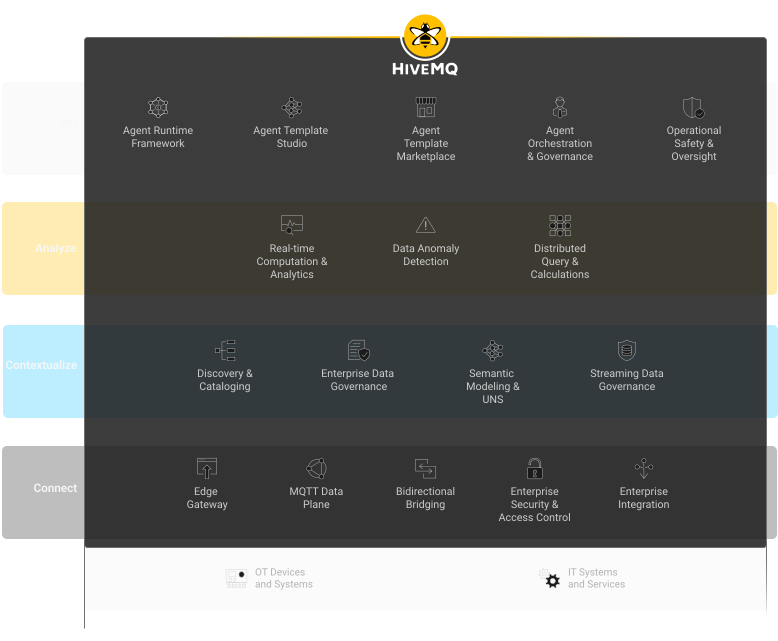
One place to move operational data, give it meaning, verify it and act on it, distributed across edge, site and cloud.

Connected is not the same as usable

Most of what an industrial estate publishes never gets used, and the reason is not collection. It is that the people closest to it cannot rely on what arrives.

No context

A value arrives with a tag name and nothing else. Which machine, which line, which batch, what normal looks like. None of it travels with the number.

No trust

Structures drift, sites name things differently, and nobody can say whether a reading is right. So teams build around the data rather than on it.

No reuse

The pilot works at site one and gets rebuilt at site two, because none of the modeling, governance or logic carried over.

No accountability

An agent acts on a value nobody checked. A tag was renamed or a sensor drifted, and afterwards nobody can reconstruct what the data really was.

Four steps, and each one makes the next possible

01

Connect

Move operational data reliably across OT, IT, edge and cloud, on one backbone instead of point integrations.

02

Contextualize

Give every signal shared meaning and a governed structure, so the data can be trusted before anyone builds on it.

03

Analyze

Turn trusted data into operational intelligence, computed where the data is created rather than in a warehouse.

04

Act

Put that intelligence to work in governed workflows, with people in the loop wherever you want them.

See the platform
Connect

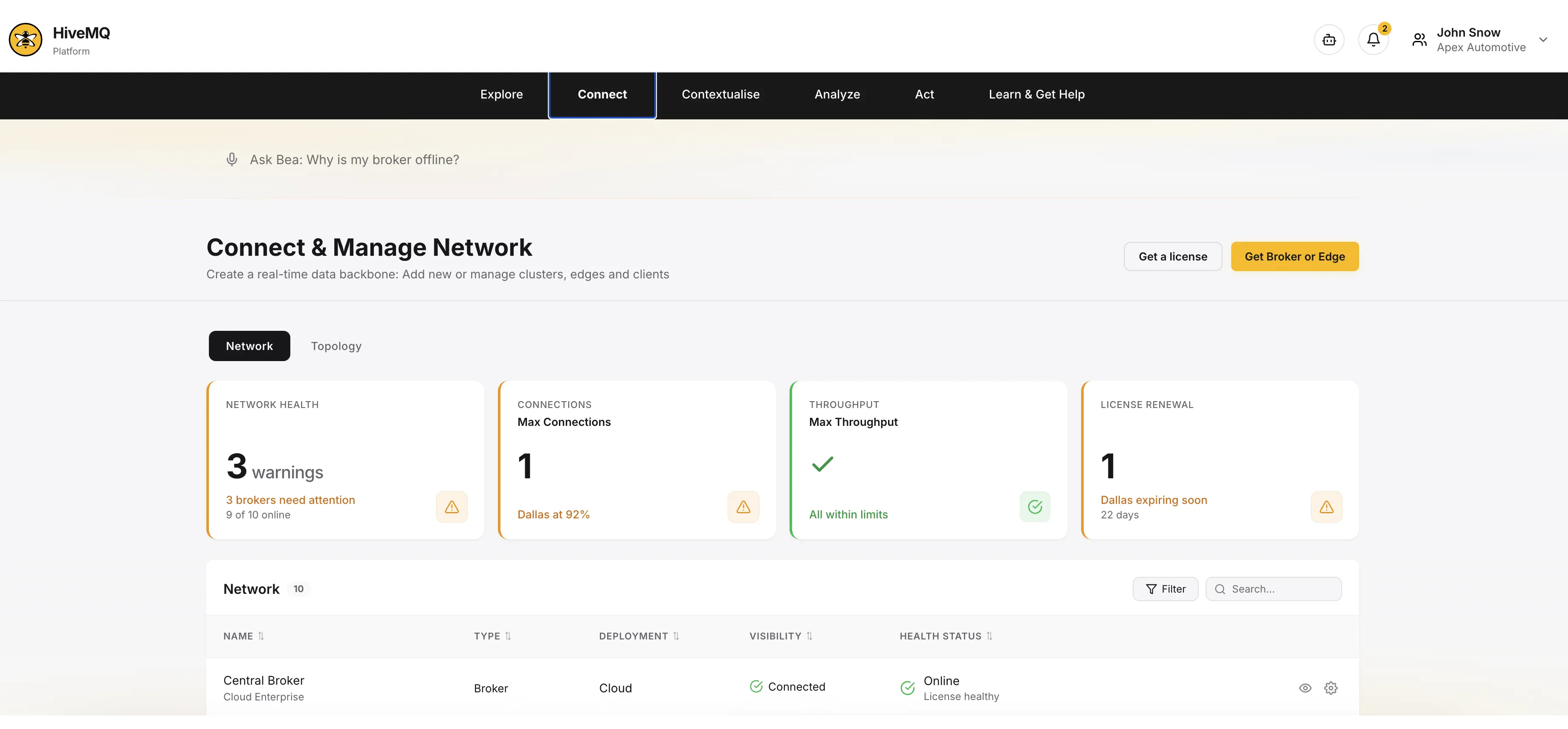
Connect

Create real-time access to operational data
Contextualize

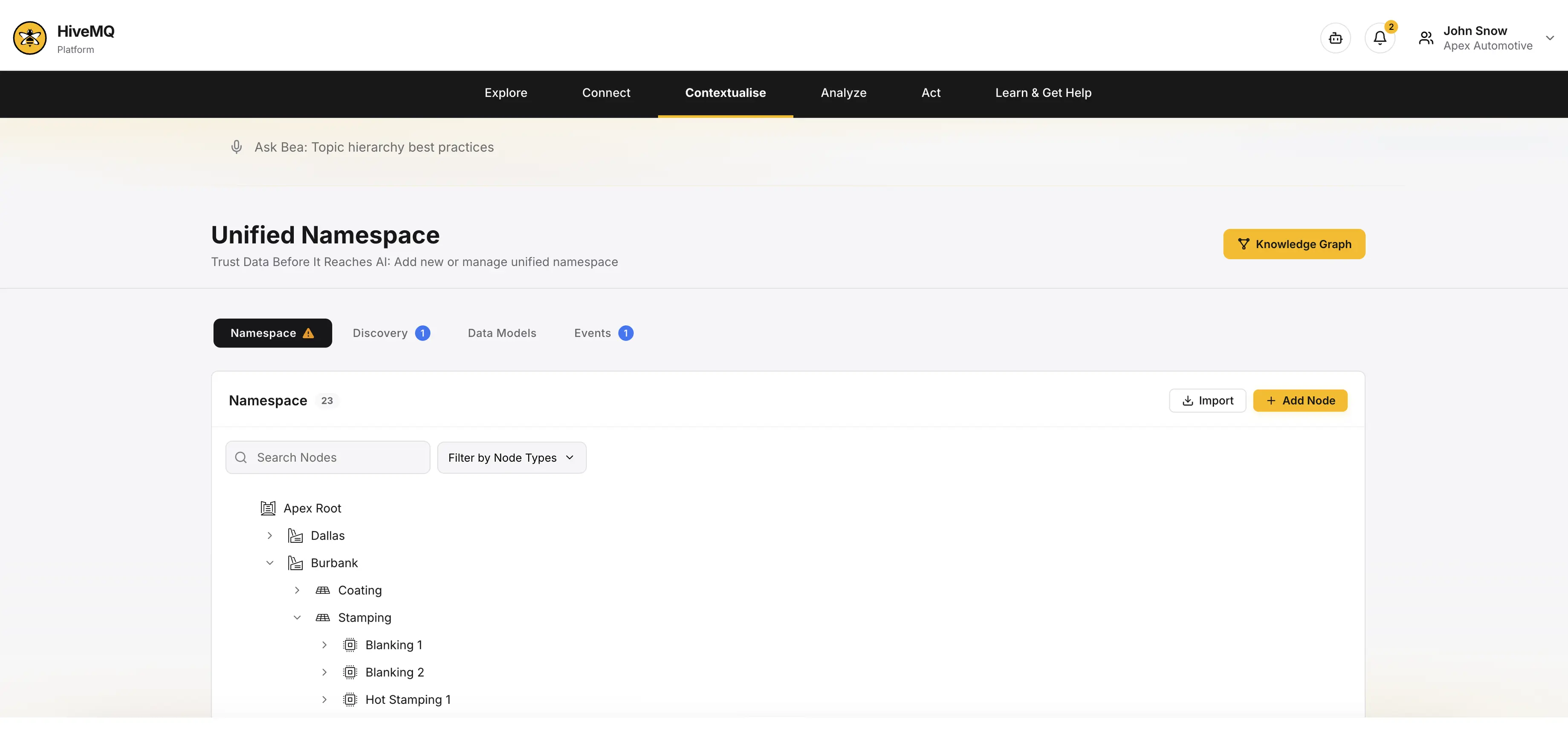
Contextualize

Create trusted operational context
Analyze

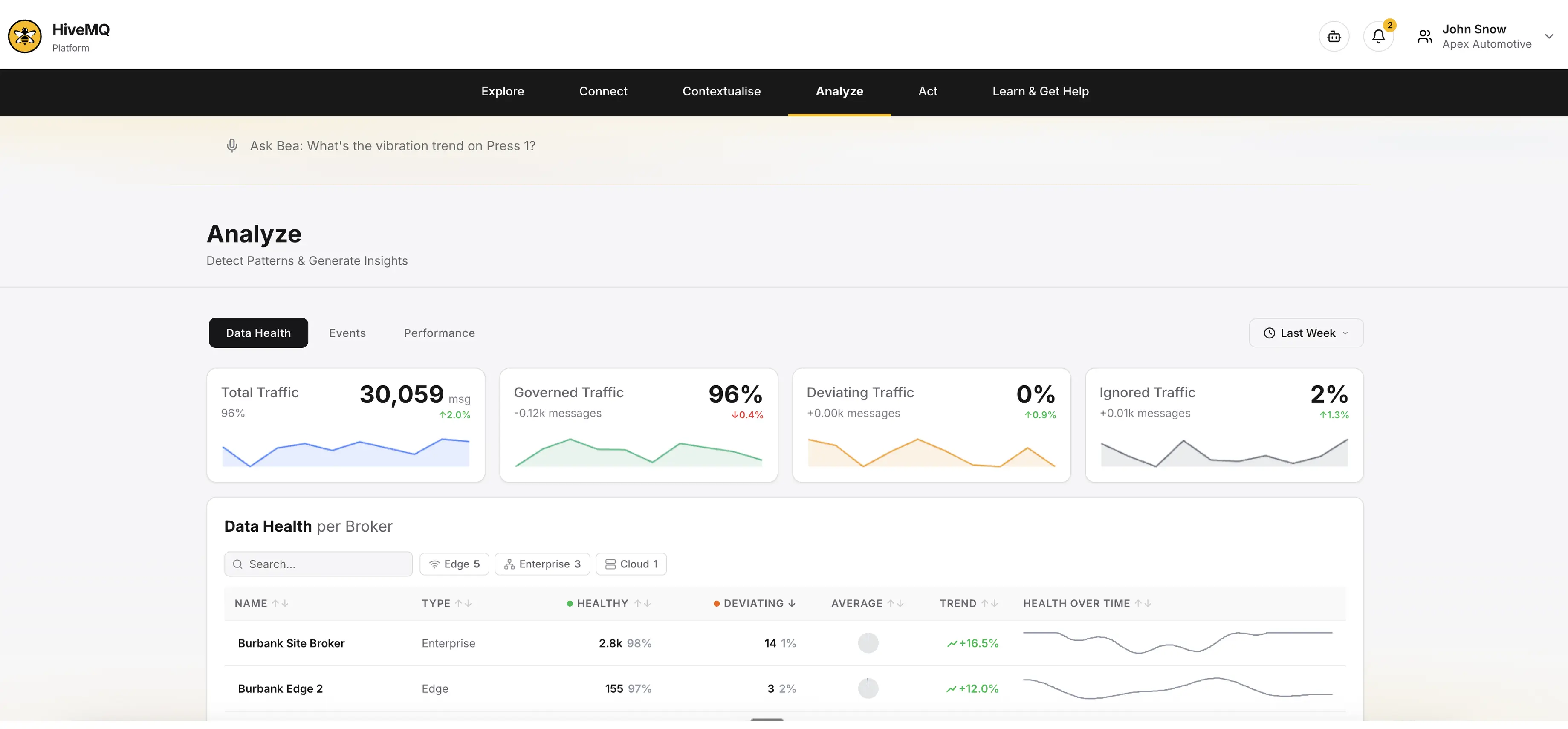
Analyze

Turn operational data into intelligence
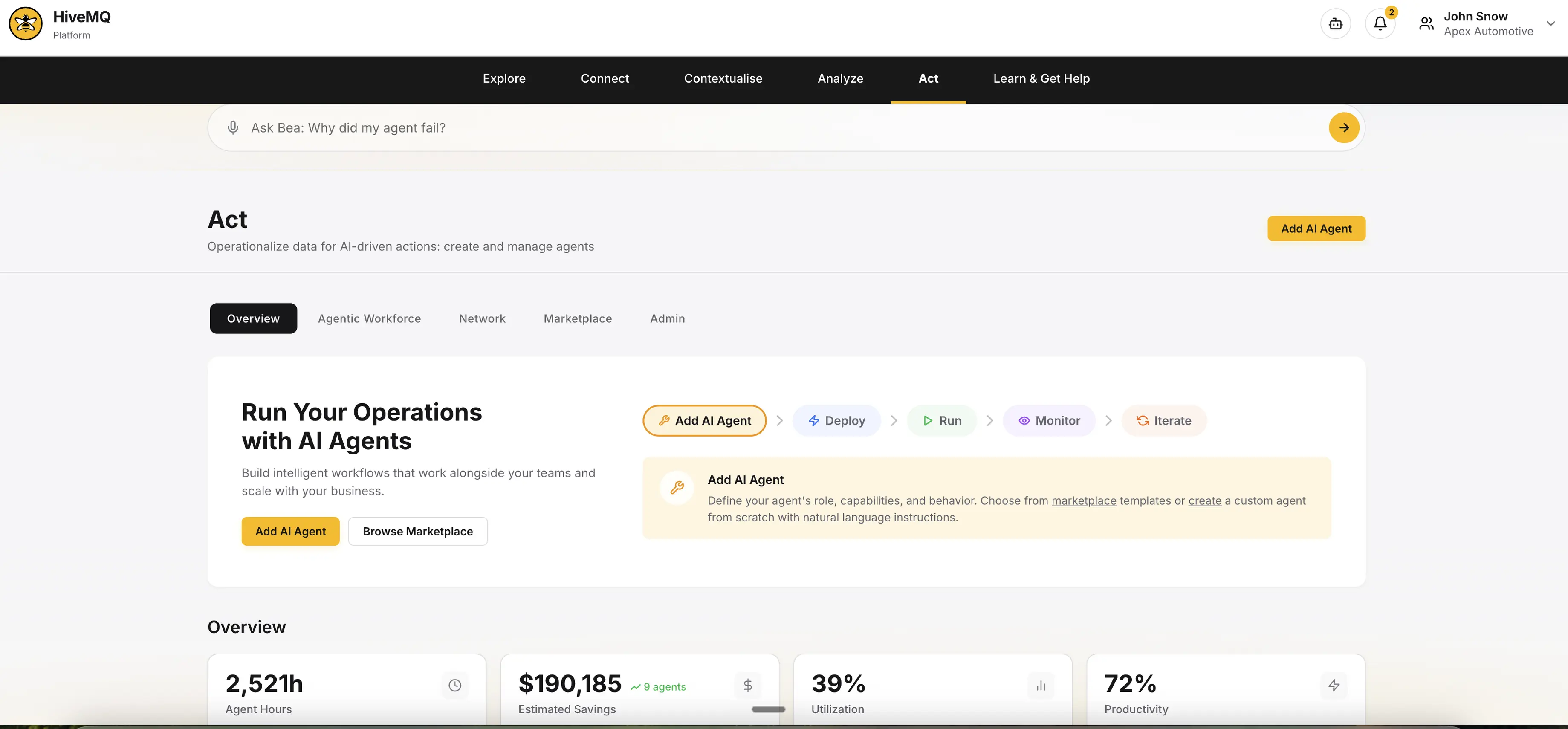
Act

Act

Move from intelligence to governed action

What changes when the data underneath works

One definition at every site

The metric means the same thing in every plant, so a comparison survives challenge and the Monday review runs on one set of figures instead of twenty spreadsheets that each got there differently.

See a deviation and fix it in real time

The problem shows up on the line that is running, not in tomorrow's report, so the people standing next to the machine can still do something about it.

Every use case after gets easier

Model, govern and connect a site one time. The next project starts from what already exists instead of rebuilding the plumbing underneath it, so each one costs less than the last.

Where this shows up in the business

HiveMQ removes the data constraint. Your team, your applications and your process work deliver the number.

Business outcome
What HiveMQ does
What you still need
Less unplanned downtime
Makes condition data available and trustworthy in time to act on it.
Your maintenance program and your condition models.
Higher OEE and yield
Makes the number consistent across sites and available while the line is still running.
Your continuous improvement team and line-level process work.
Lower cost per unit
Removes the data preparation that stalls these projects before they start.
Your energy and scrap initiatives.
Industrial AI that reaches production
Delivers inputs that are governed and continuously verified, and keeps the record of what each decision was made on.
Your use cases, your models, and your risk appetite for autonomy.

Proven where operations cannot afford to stop

The comprehensive data gathered through HiveMQ provides a fertile ground for developing and deploying a multitude of AI-driven use cases.

Gopalakrishnan Rajaram

Solution Architect, Ford

HiveMQ has delivered the stability and reliability that we require for 4 years now and it has not gone down.

Marius Hertfelder

Chief Software Architect, Mercedes-Benz

ISO 27001 certified · SOC 2 Type II · TISAX · 10+ years in production · See the security and compliance detail

Frequently asked questions

The HiveMQ Platform is the Industrial Data Platform for Agentic AI. It connects, contextualizes, analyzes and acts on industrial data right where it's created - in the plant, at the edge, on-prem or in the cloud. Data is processed close to the machines, while data models and governance are defined centrally and applied at every site. It runs as one platform, with one account and one console, built on HiveMQ Broker and HiveMQ Edge and the MQTT protocol. Teams use it to turn real-time operational data into trusted, governed intelligence that AI and people can act on.

An industrial data platform for agentic AI is the foundation that gives AI agents trusted, real-time, contextualized operational data, plus the governance to act on it safely. It connects OT and IT systems, contextualizes data with shared models so every asset means the same thing everywhere, analyzes it close to the source and carries governed actions back into operations with people in control. HiveMQ provides this foundation on an MQTT-based backbone and a governed Unified Namespace (UNS).

OT data is AI-ready when a model or agent can use it without site-specific cleanup: it arrives in real time, means the same thing at every site and is validated before anything acts on it. First, connect machines, PLCs and existing systems to one real-time backbone, so each source is published once instead of being wired to every application. Second, define common data models in a governed Unified Namespace (UNS) and enforce them, so non-conforming data is caught in the stream, not in the data lake. Third, monitor data health and calculate KPIs close to the source, so people and AI work from the same numbers. The HiveMQ Platform covers these steps across its Connect, Contextualize and Analyze layers, and Act turns the results into governed action with people in control.

They are the four layers of the HiveMQ Platform. Connect, built on HiveMQ Broker and HiveMQ Edge, creates a resilient real-time backbone across OT and IT. Contextualize defines data models and governance once and applies them consistently through a governed UNS. Analyze calculates trusted KPIs close to the source and surfaces deviations while operations are running. Act, currently in public preview, puts that intelligence into governed, human-supervised workflows. Teams can start with one layer and add the others on the same foundation.

No. The HiveMQ Platform is additive. It meets data where it already lives, connecting existing PLCs, SCADA, MES, ERP, historians and cloud services instead of replacing them. Many teams already run HiveMQ as their real-time MQTT backbone or Unified Namespace, and they add contextualization, analysis and governed action on top of that architecture. Because it is built on the open MQTT standard, data stays accessible to the tools you already use.

Yes. HiveMQ Broker remains the foundation of the HiveMQ Platform's Connect layer, and it is 100% compliant with MQTT 3.1, 3.1.1 and 5. Teams that only need a reliable MQTT broker can still deploy it self-managed, fully managed in the cloud or hybrid. The HiveMQ Platform builds on that same broker to add a governed Unified Namespace, operational intelligence and governed action, so an existing MQTT investment becomes the starting point for industrial AI.

Start with one operational improvement. Scale the results.

Start with the outcome that matters most. Prove value on the data you already have, then scale the pattern.