
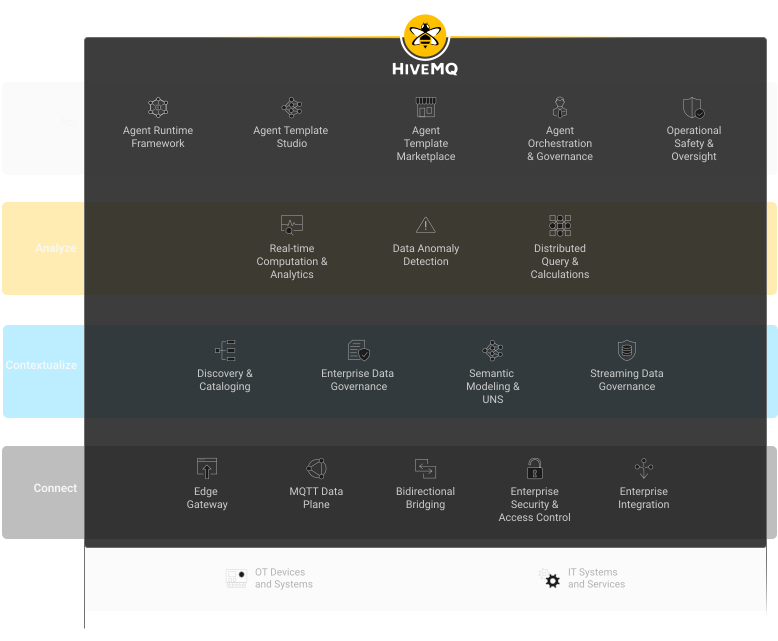
You cannot build on data that carries no context
Contextualize gives your data a structure everything else can use
Discovery & cataloging
Detect what is actually publishing, infer structure from real payloads, and surface it for a person to classify and promote into the model.
Find data across sites without asking the engineer who built it, so improvement candidates get investigated instead of abandoned.
Semantic modeling & UNS
Model sites, areas, lines, assets and signals against the ISA-95 hierarchy. Define a structure once, version it, apply it anywhere.
Turn a tag into an asset with a definition attached, so analysts stop reverse-engineering what a signal means before they use it.
Enterprise data governance
Set the standard centrally: which models are approved, who owns what, and who is allowed to change it, with role-based control.
Make the same asset mean the same thing at every plant, so cross-site comparison becomes arithmetic rather than a project.
Streaming data governance
Enforce that standard on data in motion, at the moment of publication, with schema validation and classification of every datapoint.
Apply context at the source rather than after ingestion, so modeled data lands in the lakehouse and raw exhaust does not.
What this changes
Site two costs a fraction of site one
Reports that compare across plants
AI use cases that reach production
A number people will defend
See it in the platform
:format(webp))
The comprehensive data gathered through HiveMQ provides a fertile ground for developing and deploying a multitude of AI-driven use cases.
Gopalakrishnan Rajaram
Solution Architect, Ford
Your data has a shared language. Next, turn it into intelligence.
Connect
Move operational data reliably across OT, IT, edge and cloud.
Revisit Connect →Contextualize
Give every signal shared meaning and a governed structure.
Analyze
Turn trusted data into operational intelligence.
Continue to Analyze →Act
Put that intelligence to work in governed workflows.