 TL;DR
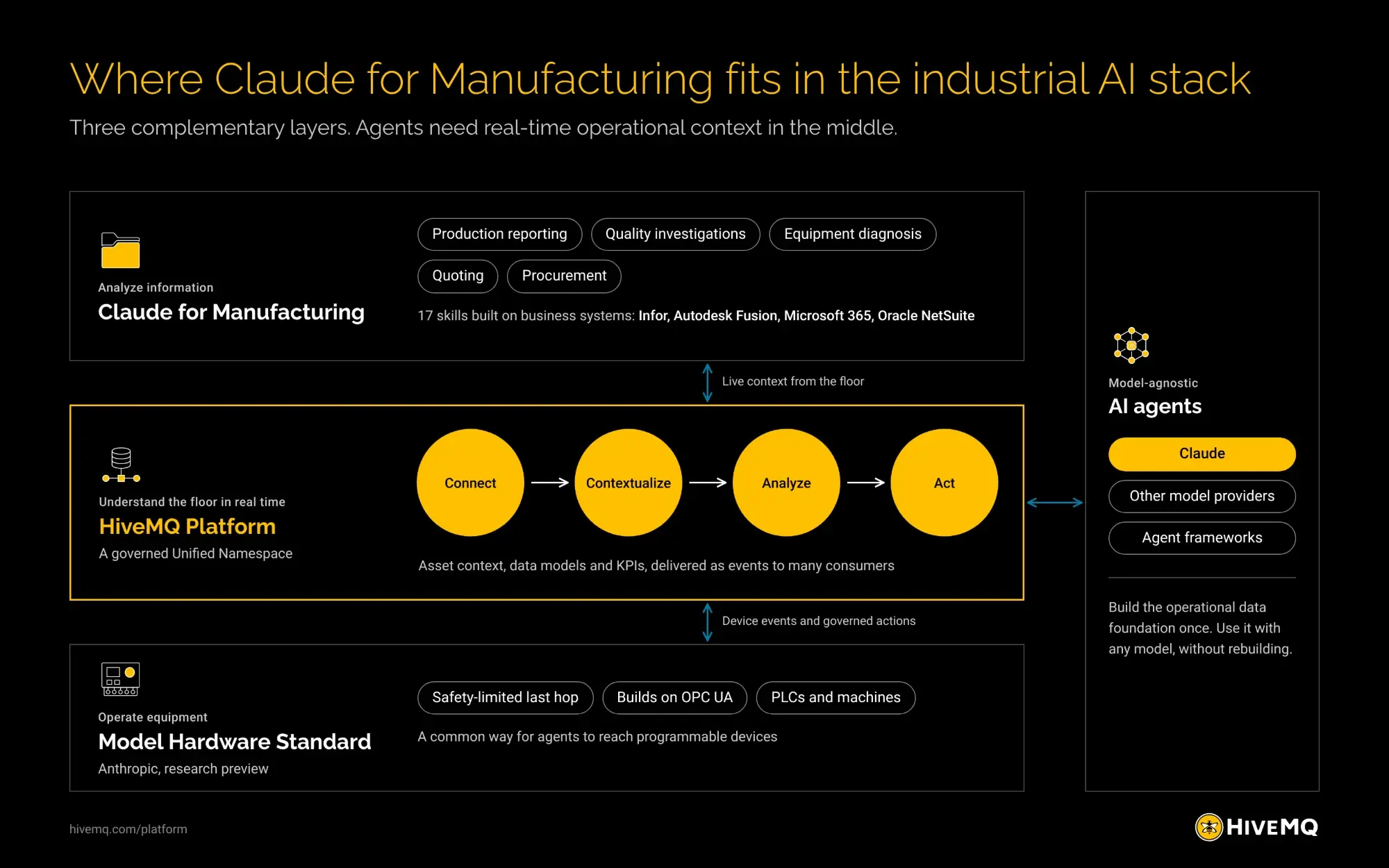
Anthropic’s Claude for Manufacturing introduces 17 AI skills for workflows such as production reporting, quality investigations, and equipment diagnosis, built on existing business systems and records. It helps people analyze manufacturing information, but AI that responds to what’s happening on the factory floor also needs real-time operational context. HiveMQ provides that foundation by connecting, contextualizing, analyzing, and acting on operational data through a governed Unified Namespace. The architecture is model-agnostic, so Claude can be one of the models powering agents on the HiveMQ Platform.
Who is this blog for: Teams evaluating what Claude for Manufacturing means for their operations, manufacturing and operations leaders shaping their AI strategy, and OT and automation engineers bringing AI closer to plant data.
Anthropic's recent launch of Claude for Manufacturing has generated considerable interest across the industrial community, and understandably so.
This is a positive development for manufacturing. It signals that frontier AI companies are moving beyond general-purpose assistants and beginning to address real manufacturing workflows.
But it also raises an important question: What does it actually take to bring AI into manufacturing operations, beyond analyzing documents and generating reports?
What Claude for manufacturing brings to the table
Anthropic's offering introduces 17 specialized AI skills for common manufacturing tasks, including production reporting, quality investigations, equipment breakdown diagnosis, quoting, and procurement.
Through integrations with systems such as Infor, Autodesk Fusion, Microsoft 365, and Oracle NetSuite, Claude can help manufacturing professionals work with existing business records, documents, and operational reports.
These are valuable capabilities that could significantly reduce the manual effort involved in everyday manufacturing workflows. But a fundamental difference exists between AI that helps people analyze manufacturing information and AI that continuously understands and responds to what's happening on the factory floor.
Claude for Manufacturing currently focuses primarily on the former. For example, equipment diagnosis can use exported sensor data and maintenance records, while production reporting can work from information extracted from existing systems. Anthropic also explicitly states that the plugin does not operate equipment.
The missing piece: Real-time operational context
Consider an AI agent tasked with investigating recurring downtime on a production line.
Analyzing historical breakdown reports is useful. But imagine if that same agent could also access the machine's current operating state, recent alarms, production performance, and relevant process conditions as events unfold.
It could begin investigating a developing issue before an engineer has to assemble the information manually. This is where the underlying industrial data architecture becomes critical.
Manufacturing environments generate enormous volumes of data from machines, sensors, control systems, and industrial applications. Simply exposing all that raw data to an LLM isn't particularly useful.
AI needs operational context, not just access to data.
It needs to understand which machine a signal belongs to, what that signal represents, how assets relate to one another, and what operational events or conditions require attention. That understanding must also remain current as conditions change.
What about the model hardware standard
Anthropic is also developing the Model Hardware Standard (MHS), a research preview separate from the Claude for Manufacturing plugin. MHS gives AI agents a common, safety-limited way to operate programmable equipment, building on existing protocols such as OPC UA. It addresses the last hop between an agent and a device. A plant still needs the layer above it: a governed Unified Namespace that tells any agent what each signal means, how assets relate, and what is happening across lines and sites, delivered as events to many consumers without each one connecting to controllers directly. The two are complementary, and both are model-agnostic.
Where HiveMQ fits into this architecture
At HiveMQ, this is precisely the problem we're addressing with our industrial data platform for agentic AI.
Our approach brings together four complementary capabilities:
- Connect: Establish real-time access to operational data from industrial equipment and systems.
- Contextualize: Organize and normalize that data into a governed Unified Namespace, with reusable data models, asset context, and derived operational KPIs.
- Analyze: Continuously monitor data health and detect deviations from the defined data structures and contracts.
- Act: Enable AI agents to monitor operational conditions, reason over contextualized data, and initiate governed actions, with human oversight where required.
With our Act capabilities, we're extending that foundation into an operational environment where agents can run continuously, be monitored and governed, and interact with plant and enterprise systems.
Importantly, this architecture is model-agnostic. Claude is one of the models that can power agents on the HiveMQ Platform, alongside models from other providers.
What this means for manufacturers
The significance of Anthropic's announcement goes beyond the specific skills included in its initial release. It reinforces a broader shift toward AI becoming an increasingly important interface to manufacturing information and workflows.
And as these capabilities evolve, the value of making operational data accessible, contextualized, and trustworthy will only increase. Manufacturers shouldn't have to rebuild their industrial data infrastructure every time a new AI model, agent framework, or application emerges.
Instead, they need a reusable operational data foundation that can serve today's analytics and automation use cases while supporting tomorrow's AI capabilities.
The opportunity isn't simply to give AI access to manufacturing data. It's to make manufacturing operations understandable and actionable by AI.
That's the foundation we're building at HiveMQ, and why we see developments like Claude for Manufacturing as an important step forward for the entire industry.
