
You cannot scale a response that waits on a person
Act turns those numbers into work that gets done
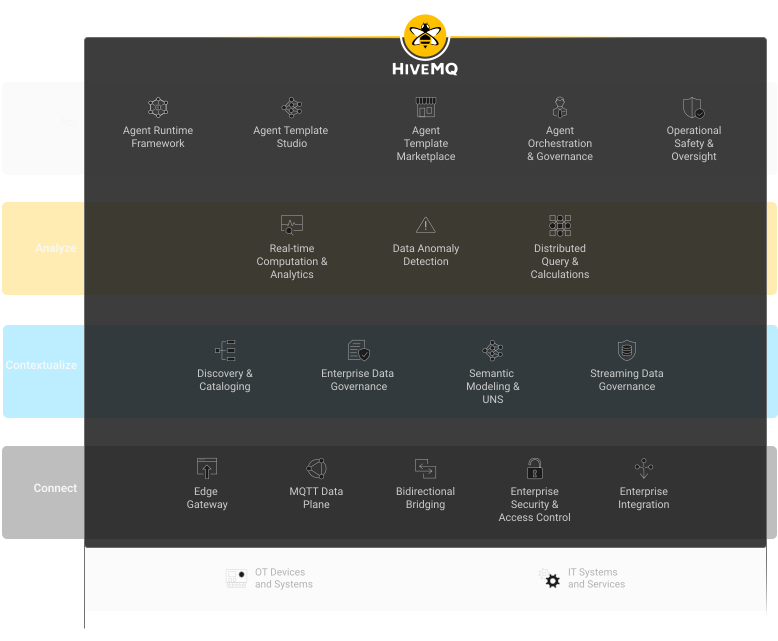
Agent runtime frameworkPreview
The engine that runs agents inside your network on Kubernetes, Docker or standalone, outbound-only and certificate-authenticated.
Have agents reason on grounded operational context rather than hand-fed schemas, and run where the process runs, including air-gapped sites.
Agent studioPreview
Author what an agent senses, reasons over and does, in plain language rather than code, and validate it in a sandbox first.
Let domain experts build agents without a data science team, so expert judgment gets captured before it retires and runs at every site.
Agent template marketplaceRoadmap
Start from a proven pattern for a known operational job rather than from a blank page.
Start from a pattern that already works, so time to value is measured per use case rather than per project.
Agent orchestration & governancePreview
Policy gates, approval steps, autonomy limits and role permissions, authored by your team and enforced by the runtime on every cycle.
Keep behaviour inspectable and bounded, so automated action clears the risk review instead of stalling in it.
Operational safety & oversightPreview
People in the loop wherever you place them, and a recorded, replayable history of every decision and the data behind it.
Make every decision attributable and reversible, so autonomy can be extended incrementally as trust is earned.
Autonomy is a dial, not a switch
Most industrial AI stalls because the only choice on offer is trust it or do not. Every agent has a setting, you choose it per use case, and you can turn it back down at any point.
Describe
Tells you what is happening. Reads only.
Diagnose
Offers a cause, using the context around the signal.
Prescribe
Proposes the action and waits for a person.
Automate
Carries it out on its own, inside the bounds your team set.
You decide what an agent is allowed to do
Scope is set by your team, not by us. Agents work on the systems and decisions you nominate, and everything outside that boundary stays outside it.
Nothing runs unattended until it has earned the lane, and every action it takes is recorded, replayable and reversible.
What this changes
Problems caught before they stop a line
Quality corrected in the moment
Expertise that stays
Faster response when a person steps in
See it in the platform
:format(webp))
You have seen the whole path. It starts with one line.
Connect
Move operational data reliably across OT, IT, edge and cloud.
Revisit Connect →Step 2Contextualize
Give every signal shared meaning and a governed structure.
Revisit Contextualize →Step 3Analyze
Turn trusted data into operational intelligence.
Revisit Analyze →Act
Put that intelligence to work in governed workflows.
Frequently asked questions
What happens when an agent is wrong?
Out-of-lane actions never execute without a person approving them. Every cycle is recorded and replayable, so a wrong recommendation is something you review rather than something you discover later.
What leaves my network?
Agents run inside your environment. Connections are outbound-only and certificate-authenticated, so nothing inbound is exposed.
Who approves an action?
You do, by role. Approval gates and autonomy limits are authored by your team and enforced by the runtime.
Can I run this without your broker?
Yes, and with sources that are not MQTT. It is better with the rest of the platform underneath, because the agent reasons on data that has already been modeled and checked, but it does not require it.