
You cannot get data to the right place at the right time
Connect moves operational data where it is needed, the moment it changes
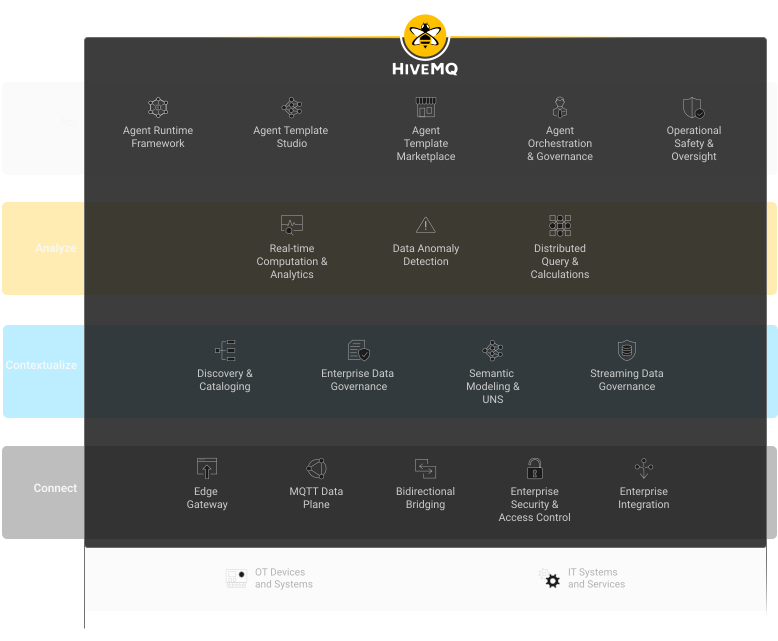
Edge gateway
Bring OPC UA, Modbus, S7 and BACnet onto the platform at the source, as software rather than an appliance on every line.
Reach legacy assets without per-line middleware or a Windows-bound gateway, so line launches and retrofits stop needing bespoke connectivity engineering.
MQTT data plane
One event-driven backbone every system publishes to and subscribes from, moving data the moment it changes rather than on a poll cycle.
Keep data through WAN loss and broker failure with no gaps to reconcile, so downtime and OEE numbers stop being reconstructed after the fact.
Bidirectional bridging
Site to region to cloud on one path, in both directions, with store-and-forward so nothing is lost when a link drops.
Run one architecture across the fleet rather than one per site, so site N+1 costs materially less than site one.
Enterprise security & access control
TLS and mTLS, topic-level permissions, role-based access and an audit trail, designed for segmented OT networks.
Carry every flow over one governed boundary, so the default answer to a new project stops being another firewall exception.
Enterprise integration
Pre-built paths into Kafka, databases, historians and cloud services, so the platform feeds what you already run.
Land operational data in the systems you already run, so a new use case goes from a project to a configuration change.
Deployed where it has to be
Self-managed on Kubernetes or OpenShift, or fully managed on AWS, Google Cloud or Azure in the region you choose.
Stop the deployment model killing the evaluation, so a sovereignty constraint and a cloud mandate land on the same architecture.
What this changes
Real-time visibility across the estate
Faster onboarding for new sites
An integration backlog that burns down
The specifics underneath
See it in the platform
:format(webp))
The components underneath
HiveMQ Broker
HiveMQ Edge
HiveMQ Extensions
HiveMQ has delivered the stability and reliability that we require for 4 years now and it has not gone down.
Marius Hertfelder
Chief Software Architect, Mercedes-Benz
Your data is flowing. Next, give it shared meaning.
Connect
Move operational data reliably across OT, IT, edge and cloud.
Contextualize
Give every signal shared meaning and a governed structure.
Continue to Contextualize →Analyze
Turn trusted data into operational intelligence.
Act
Put that intelligence to work in governed workflows.