
You cannot act on a number that arrives too late
Analyze turns that structure into numbers you can manage by
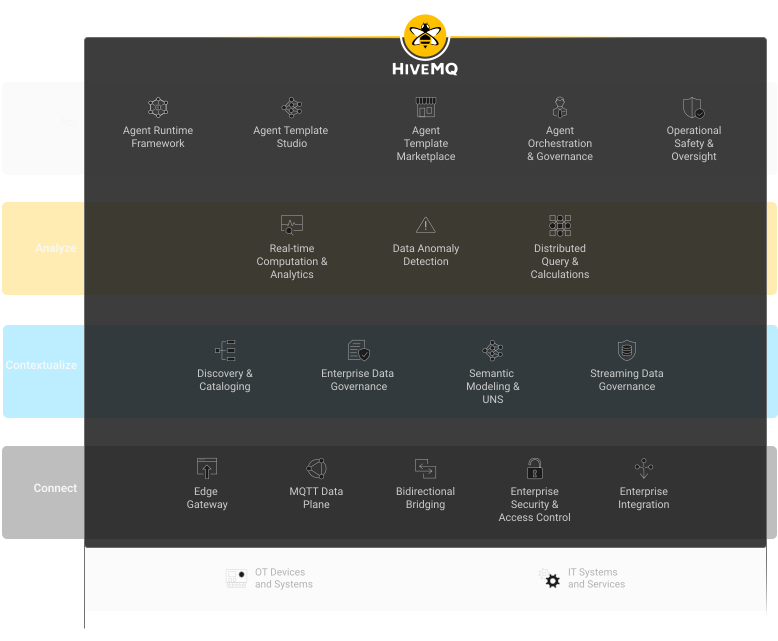
Real-time computation & analytics
Derive the values your operation manages by, computed on the stream as data flows rather than after it lands somewhere else.
Calculate OEE and downtime once, consistently, near the line, so the floor and corporate argue about the cause instead of the number.
Event & anomaly detection
Watch for the conditions that matter to you and for the patterns that do not fit the established behavior of an asset.
See a deviation while the line is still running, so root cause takes minutes rather than days and problems get caught before they become scrap.
Distributed query & calculations
Ask a question once and have it answered where the data lives, across sites, without moving anything to a central store first.
Stop the decision loop depending on a cloud round trip, so latency-sensitive and sovereignty-constrained use cases become possible at all.
Operational benchmarks & baselines
Establish what normal looks like per asset, per line and per site, and measure live behavior against it continuously.
Know what normal looks like per asset, so a real problem and a noisy sensor stop looking identical and plants can be compared on terms that match.
What stops an agent acting on data that is wrong
Everyone in this category sells agents. Almost nobody says what happens when the input is bad. This is that answer, and it is what makes delegating anything defensible.
It does not match the model
Wrong type, out of range, a missing field, unit drift, or a tag renamed underneath you.
It stops at the injection point
Quarantined before anything consumes it. Downstream holds at the last good value rather than silently ingesting a bad one.
A person sees it in time
Expected schema and actual payload side by side, with the broker and the device named, while the shift is still running.
What was true, and when
The input is kept with the decision that was made on it, which is what makes an automated action defensible afterwards.
This is not a historian, and it is not your BI stack
Your warehouse and your analytics tools keep doing what they do well. This is the intelligence that runs in the operational plane, on data that has already been governed, so decisions can be made at the speed the line moves.
We are built to sit underneath that stack, not to replace it. Supported paths into Snowflake, Databricks, Kafka, Kinesis, Pub/Sub and your historian, so what reaches them is already modeled and already checked.
What this changes
Decisions at the speed of the line
Questions worth asking again
One yardstick across the fleet
See it in the platform
:format(webp))
You have numbers you can rely on. Next, put them to work.
Connect
Move operational data reliably across OT, IT, edge and cloud.
Revisit Connect →Step 2Contextualize
Give every signal shared meaning and a governed structure.
Revisit Contextualize →Analyze
Turn trusted data into operational intelligence.
Act
Put that intelligence to work in governed workflows.
Continue to Act →