TL;DR
No, AI is not the answer. Not until you teach it how to be.
The main thing that drives scale is reusability. Scalability hinges on long-term reusability that can be achieved by enriching data with embedded context.
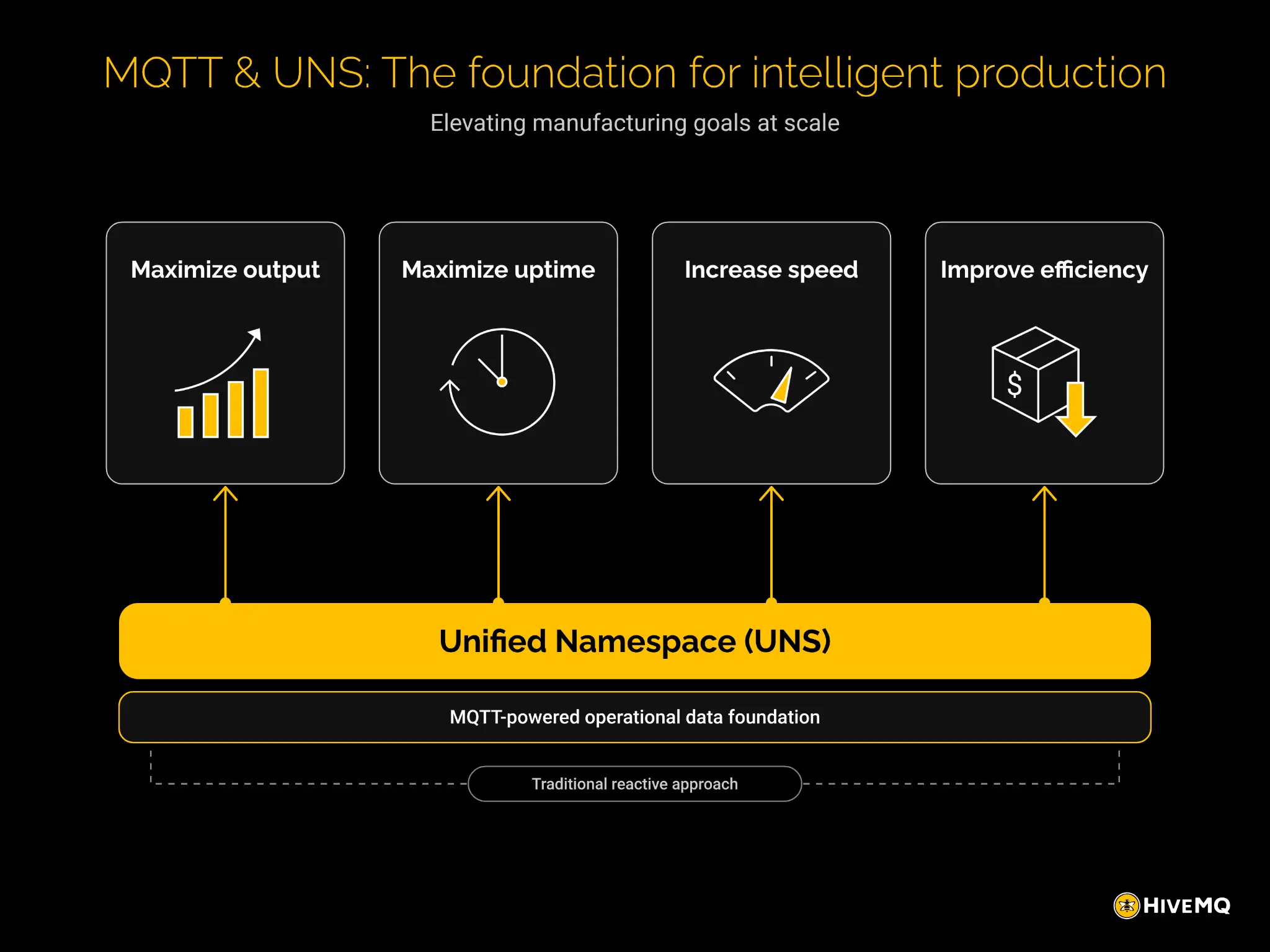
- Intelligent production elevates the good old manufacturing goals: produce more, faster, cheaper, accurately.
- The problem is not lack of data, but the required context and logic that are trapped within applications, forcing every other application to reinvent them from scratch.
- Modern systems need to make data available for the future applications including AI agents.
- Data should be enriched with context and integrated into the Unified Namespace (UNS) as close to its source as possible, eliminating guesswork and manual analysis.
- User-defined data models establish clear standards for data governance, elevating non-conforming data to match published specifications. This guarantees downstream data readiness, eliminating the overhead of investigating how to process incoming information.
- The HiveMQ Platform, combined with HiveMQ Brokers, manages the heavy lifting seamlessly so you don’t have to.
Who this blog is for: from OT to IT to BI to AI Agent Builders that use IIoT data.
Introduction: The operational data paradox
Data output is exploding across factory floors, yet operational impact remains stagnant. Up to 80% of industrial data is never used. In part, this is because raw signals lack context - the very context required for industrial AI solutions to deliver real-time clarity rather than stalling due to poor data plumbing.
Enterprise scaling ultimately fails when facilities lack a shared data standard. Single-line pilots are easy, but enterprise-wide transformation requires fixing the data foundation first.
Elevating manufacturing goals through intelligent production
Digital transformation isn't just about adopting new tools; intelligent production directly elevates traditional manufacturing goals - producing more, faster, cheaper and accurately - by replacing reactive friction with real-time, data-driven outcomes:
- Produce more: Maximize throughput and capacity utilization without investing in additional capital equipment.
- Produce faster: Eliminate operational latency and bottlenecks to accelerate overall cycle times.
- Produce cheaper: Minimize unit costs by stripping out material, energy, and process waste.
- Produce accurately: Consistently hit precise quality and yield targets across all shifts using proactive health tracking.
Key metrics like OEE and throughput can no longer remain post-shift autopsy reports. When data is enriched with real-time operational context, these metrics automatically trigger proactive adjustments before quality drops or speeds lag.
MQTT and the Unified Namespace (UNS) provide the underlying data architecture to make this possible, creating a self-describing operational layer that detects and resolves efficiency losses instantly.
Why digitalization value fails: The application-centric trap
Building digital architecture application-by-application traps logic inside isolated software siloes. Point-to-point integrations require constant maintenance and duplicate work across every new tool.
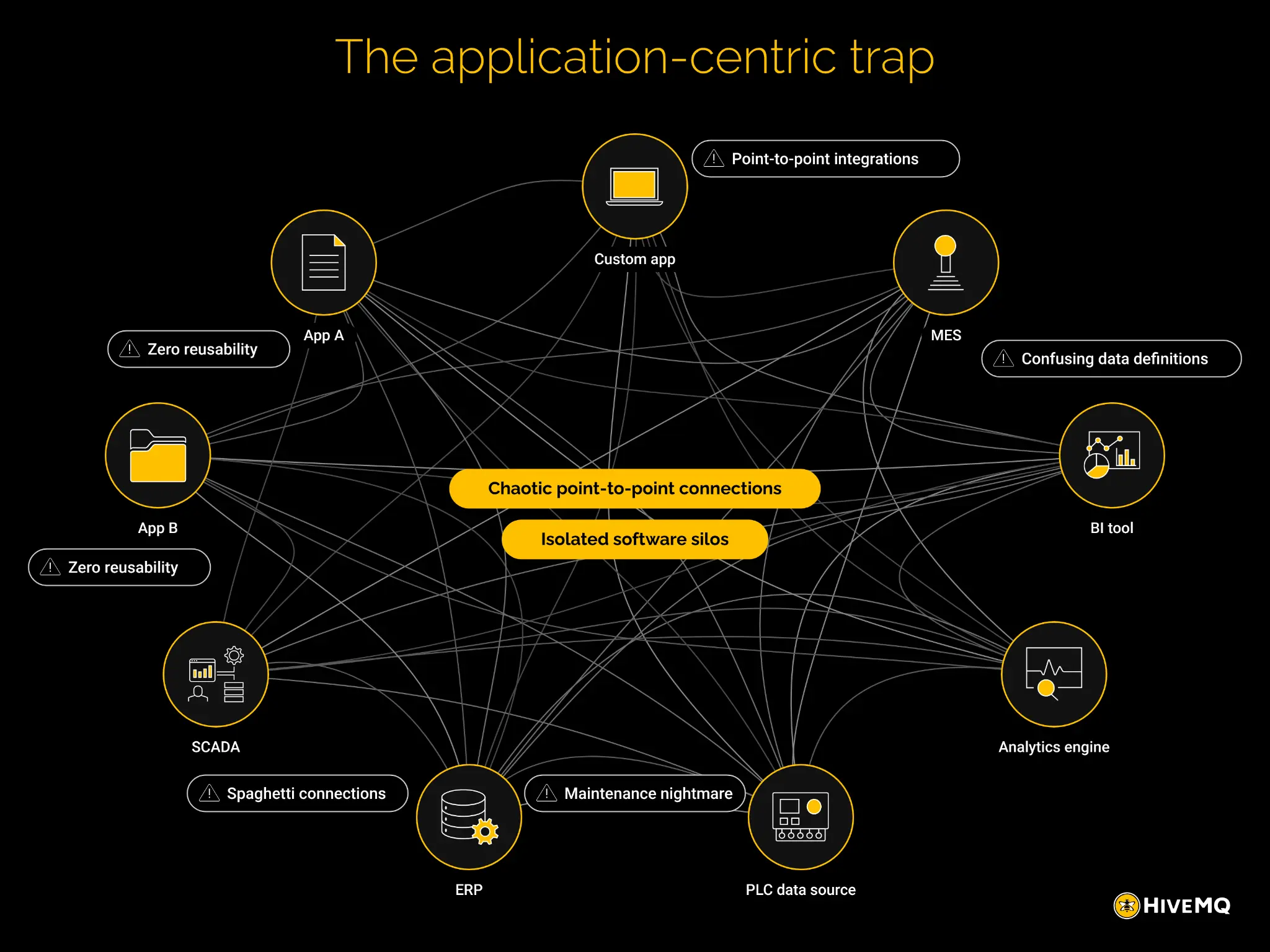
The application-centric path breaks scalability:
- Spaghetti Connections: Every new analytics tool forces direct custom ties to underlying hardware.
- Redundant Mapping: Each vendor platform independently re-analyzes raw register values from scratch.
- Conflicting Definitions: Disconnected data logic results in different teams reporting different OEE metrics for the same line.
- No Reusability: Custom integrations cannot scale from Plant A to Plant B without full rebuilds.
Data reuse is impossible when logic lives in applications. Enrich data at the broker level near the source, and every downstream consumer instantly inherits standard context.
A reusable data foundation: Connect, contextualize, analyze, act
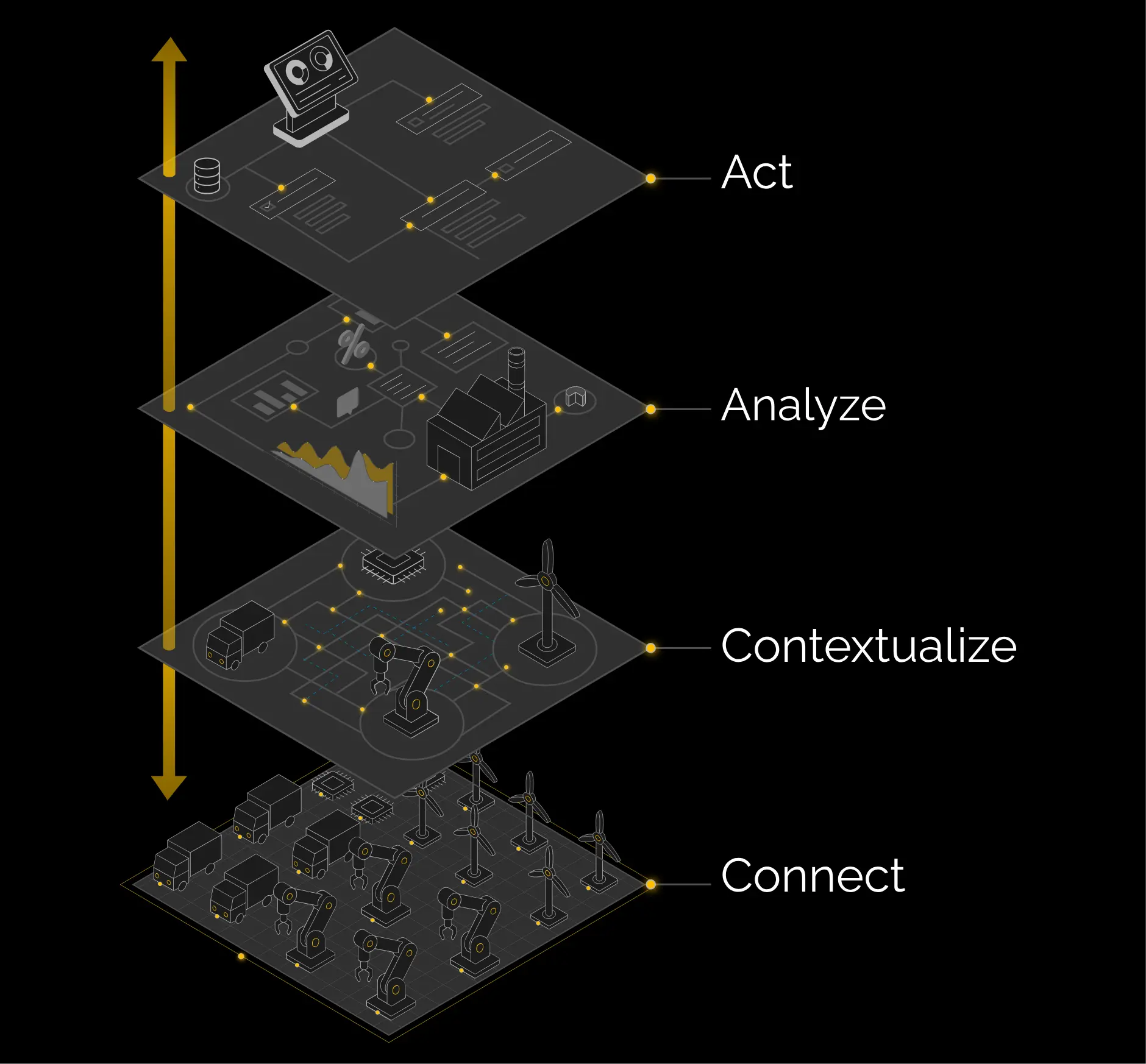
Modern scaling demands that context and business logic be decoupled from legacy applications. Achieving this while increasing data usability depends on four core capabilities:
- Connect: Build a real-time MQTT backbone across OT, IT, edge, and cloud to eliminate point-to-point integrations.
- Contextualize: Standardize raw register values with semantic modeling in a Unified Namespace before sending data downstream.
- Analyze: Evaluate streaming data in real time against performance baselines to catch operational anomalies early.
- Act: Route structured insights directly to operators, workflows, and AI agents within governed, human-in-the-loop paths.
The above capabilities establish a reusable foundation for operational intelligence, but understanding how they work together in practice is equally important. For a closer look at the HiveMQ platform architecture and workflows, read Exploring the HiveMQ Platform: From connectivity to AI-driven action.
Enable governed AI agents with contextualized industrial data
Without a robust data foundation anchored in a governed operational context, deploying off-the-shelf AI tools across the factory floor will inevitably grind to a halt. Enterprise architectures must root intelligent systems within standardized, facility-wide data models. This eliminates the need for AI agents to constantly interpret raw register values and re-architect plant logic for every query. Operational integrity relies on human-in-the-loop governance: AI agents evaluate context and propose optimal adjustments, but execution must follow deterministic control paths with established safety protocols.
To maintain operational integrity, agentic workflows require structured, human-in-the-loop governance:
Observe ⇒ Reason ⇒ Recommend ⇒ Human Approval ⇒ Execution
High-quality data powers AI agents to analyze complex systems and recommend optimal actions, but final execution must remain strictly anchored in deterministic safety protocols. AI elevates industrial data architecture—it doesn't replace it.
Conclusion: Build once, create value repeatedly
Ditch one-off custom projects. Sustainable scale relies on building reusable data capabilities:
- Connect: Establish a single MQTT backbone once so data can be reused across all downstream systems without custom integrations.
- Contextualize: Embed semantic context near the source so every application consumes standardized, reusable data.
- Analyze: Evaluate unified streaming data continuously to extract reusable operational insights across the enterprise.
- Act: Deliver structured, actionable outputs directly to operators and AI agents from a single source of truth.
Stop reinventing custom integrations. Establish an enriched data architecture to scale future use cases effortlessly.
Making data reusable also requires deciding where context should live and how much information should travel with each message. Explore these architectural trade-offs in Contextual modeling strategies to reduce manufacturing data volume.