The HiveMQ team is excited to announce the release of HiveMQ Enterprise MQTT Platform 4.50. This release expands Data Hub support in Control Center v2 with a new overview dashboard and detailed views, adds a new HiveMQ licensing model, enhances usage statistics, and includes several fixes and improvements.
Highlights
- Expanded Data Hub Management in Control Center v2
New Data Hub Management Capabilities in HiveMQ Control Center v2
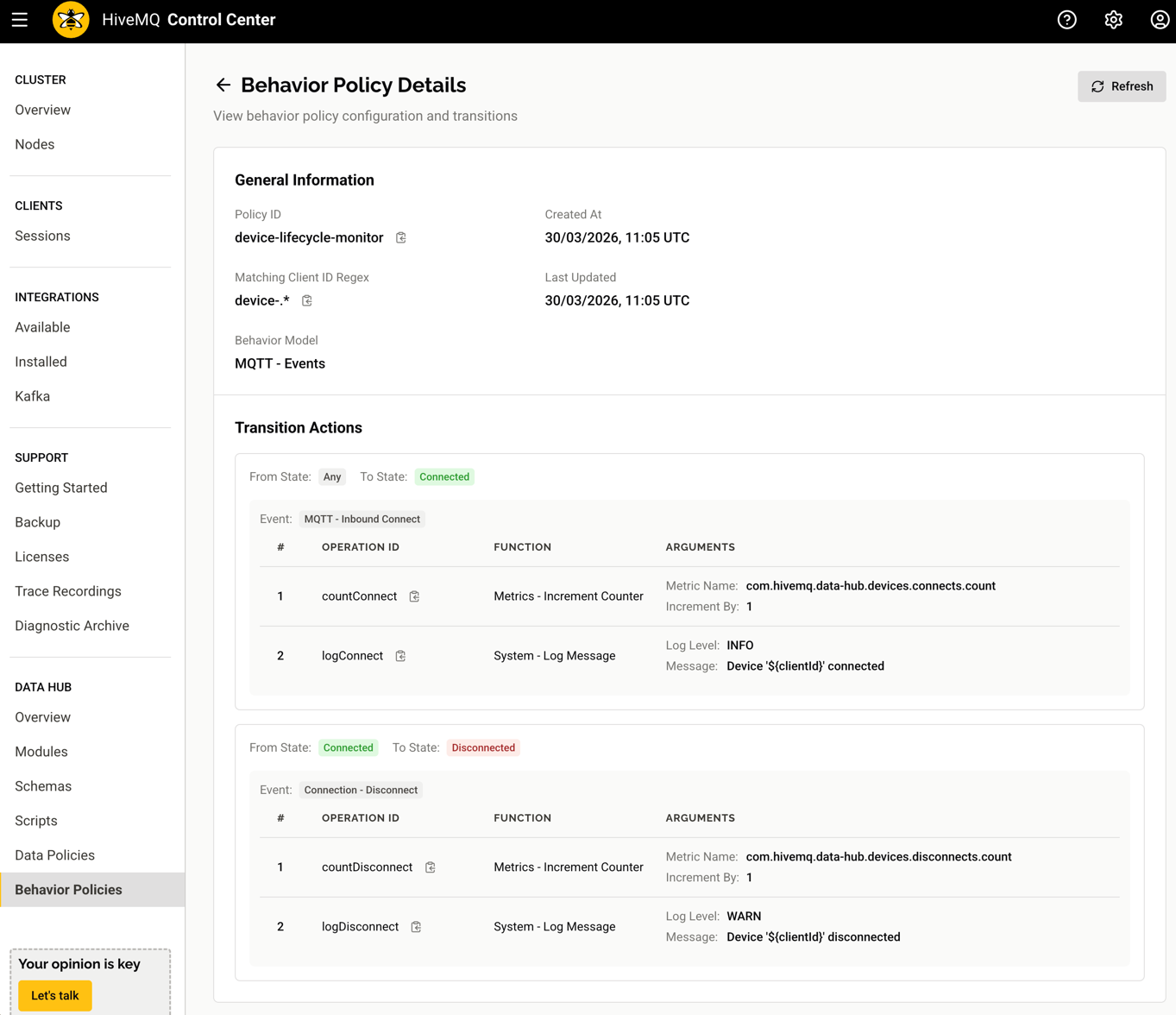
Building on the list views we introduced in HiveMQ 4.49, HiveMQ 4.50 further expands Data Hub support in Control Center v2 with an overview dashboard and detailed views for schemas, scripts, data policies, and behavior policies.
NOTE: This release continues the incremental rollout of Data Hub support in Control Center v2. Additional management capabilities will follow in upcoming releases.
How it works
Navigate to the Data Hub section in Control Center v2 to access the new overview dashboard and detailed views.
Overview Dashboard
Displays key policy activity metrics such as failed policy counts.
Schema and Script Details Views
Select any schema or script from the list view to open its detail view. From there, you can inspect the full definition, review version history, and download artifacts.
Policy Details View
Select any data policy or behavior policy to see its full configuration, including matching rules, validators, and action pipelines.
How it helps
This second milestone in Data Hub support expands cluster visibility and improves usability in Control Center v2. This update enables you to:
- Quickly assess the health of your data pipelines from the overview dashboard.
- Inspect the full configuration of any schema, script, or policy.
- Troubleshoot policy failures faster with detailed access to all related resources.
For more information, see the Data Hub documentation.
More Noteworthy Features and Improvements
HiveMQ Platform Docker images now ship with Java 21.0.10: This Java version deprecates outdated TLS_RSA cipher suites and SHA-1 signatures. For detailed information on how the recent Java security updates impact HiveMQ deployments, see Critical Java Security Update: TLS_RSA Deprecation in JDK-21.0.10 and JDK-25 Can Cause MQTT Connection Failures.
Changes to the HiveMQ Platform Docker images only affect Docker-based deployments. Bare-metal and VM-based deployments are not affected.
New HiveMQ Usage Statistics: Starting with HiveMQ 4.50, the broker includes a new usage statistics function that sends data periodically to https://analytics.hivemq.com/v2. The new function runs alongside the existing anonymous usage statistics and collects the same data, plus the following additional information:
- Cluster identifier
- Basic license information
- Message usage metrics
- Extension IDs
This data helps us improve the platform, plan compatibility, and support the extension ecosystem.
During a transition period, both functions run in parallel. The new function cannot be disabled. For more information and a full list of collected data, see Usage Statistics in the documentation.
HiveMQ Enterprise MQTT Broker
- Introduced a new platform license type with HTTP-based license validation, cluster-wide synchronization, and automatic refresh scheduling that enables seamless self-serve license management from the HiveMQ portal. See the documentation for more details.
- Added CPU, memory, I/O, and process limit metrics for deployments that run in Linux containers with cgroup support. See the documentation for more details.
- Added the ability to export metrics history into the diagnostic archive as Parquet files to facilitate support analysis.
HiveMQ Enterprise Security Extension
- Fixed an edge case in ESE variable substitution (
${..}) that could cause incorrect behavior.
HiveMQ Control Center v2
- Added an option to activate the 5-hour Data Hub trial mode.
Get Started Today
To upgrade HiveMQ from a previous version, follow the steps in the HiveMQ Upgrade Guide and review the Known Issues section for any considerations that could affect your deployment.
To learn more about all the features the HiveMQ Platform offers, explore the HiveMQ User Guide.